Friday, February 18, 2011

Pharmacia, or Maybe Pfizer Settles, Only Eight Years Later

Didn't somebody say "justice delayed is justice denied?"* 

Here is a story for a Friday afternoon, via a press release from the New York state Attorney General's office, per Bloomberg:
Attorney General Eric T. Schneiderman today announced a multimillion dollar settlement with a pharmaceutical company that inflated the cost of drugs sold to state health programs. The company, Pharmacia Corporation, has paid $2.5 million to the New York Medicaid program and to the Elderly Pharmaceutical Insurance Coverage Program (EPIC), and also to cover the costs of the investigation.

Here is more information about the lawsuit:
The lawsuit, filed in 2003, charged that Pharmacia failed to report real and accurate prices, and did not take into account discounts, rebates, chargebacks and other price concessions to their wholesalers. As a result, New York's Medicaid Program and the EPIC program paid more for certain drugs manufactured by Pharmacia than those state programs should have.

This is an unusual entrant into our march of legal settlements. As noted above, this lawsuit took eight years to settle. The entity that made the settlement, Pharmacia, is actually long gone as an independent company. It merged into Pfizer in 2003 (see this). Despite the eight years of waiting, the settlement is extremely paltry compared to the size of the company to which the settlement now applies. According to Google Finance, in 2010, Pfizer's annual revenues were more than $67 billion.

This settlement adds in a small way to a series of settlements Pfizer has recently made.  Pfizer paid a $2.3 billion settlement in 2009 (see post here), and three other major settlements from then to early 2010 (see post here).  The company was listed as one of the pharmaceutical "big four" companies in terms of defrauding the government (see post here).  For other discussions of Pfizer on Health Care Renewal, look here

The New York Attorney General's press release claimed, "These are hard financial times for our state, and my office will do its part by uncovering every dishonestly claimed dollar, and holding those who take advantage of New York accountable."  Begging his pardon, but could he really have been serious that nicking Pfizer for $2.5 million eight years after the lawsuit was filed is really holding this giant company accountable?  Will this settlement make the company any more accountable than all those that came before, some almost one thousand times bigger?  Meanwhile, as is usually the case in these stories about the march of legal settlements in health care, no person who authorized, directed or implemented the questionable activity apparently paid any penalty or suffered any sort of negative consequences.

This week, Matt Taibi asked "why isn't Wall Street in jail?" in the title of his most recent Rolling Stone article.  I should also ask, why aren't some leaders of pharmaceutical, device, biotechnology, and managed care corporations in jail? 

Just as the leaders of big financial service firms seem to be completely unaccountable for the havoc they created in the global economy, and despite bluster by various government officials, the leaders of big health care corporations seem to be completely unaccountable for the unethical behavior of their companies that continue to inflate the health care bubble.

So for the nth time I will repeat:  we will not deter unethical behavior by health care organizations until the people who authorize, direct or implement bad behavior fear some meaningfully negative consequences. Real health care reform needs to make health care leaders accountable, and especially accountable for the bad behavior that helped make them rich.

Meanwhile, the continued unwillingness of government leaders to take on corporate leaders suggests how corporatist the US has become. Government for the corporations, by the corporations, and of the corporations, bodes no good for the people whose rights are increasingly being displaced.

Mr Taibi encapsulated the problem in a more colorful way, and I will end with his version, somewhat edited for this family publication:
Over drinks at a bar on a dreary, snowy night in Washington this past month, a former Senate investigator laughed as he polished off his beer.

'Everything's f***ed up, and nobody goes to jail,' he said. 'That's your whole story right there. Hell, you don't even have to write the rest of it. Just write that.'

* - the quote has been attributed to William Gladstone in a 1868 speech. but may be older than that (link here)

Thursday, February 17, 2011

After Manufacturing Problems, Genzyme CEO's Golden Parachute Means "Failure = Success"

In late 2009, I posted about problems at a Genzyme plant that manufactured some fabulously expensive drugs, e.g. Cerezyme whose cost to patients approximated $160,000 a year. We thought then that for a drug costing that much, the company ought to have figured out a conservative process to provide pure and unadulterated product. In a later post I asked why a company that could afford to make its CEO very rich could not afford to adequately maintain its manufacturing facilities. In May, 2010, I posted about a legal settlement of charges related to its manufacturing problems requiring Genzyme to pay a $175 million fine and function under US government supervision.  And in August, 2010, I posted about how this series of management missteps could lead to the company's CEO becoming even richer because they lead to a declining stock price, which increased the likely that the company would be bought out, which could trigger the CEO's golden parachute.  I suggested then that were this to happen, it would be a gross example of how massively perverse incentives stupendously reward the top brass of health care organizations for mediocre, or worse leadership and bad results for both patients/ clients/ customers and stock-holders alike.

Now it  looks like this will happen.  Yesterday, the Boston Globe reported:
Ggenzyme Corp., the largest biotechnology company in Massachusetts and one of the industry’s historic pioneers, has struck a definitive agreement to be bought by French pharmaceutical giant Sanofi-Aventis SA, in a deal valued at about $20.1 billion.

As a result of this deal,
Genzyme’s high-profile president and chief executive, Henri A. Termeer, who has run the company for 28 years, will resign following the close of the transaction. But he will advise Sanofi on integrating the two companies. Termeer built the company into a global operation with 10,000 employees worldwide and a business model that has been the envy of the biotechnology industry. He turns 65 on Feb. 28.

Termeer, though fiercely proud of Genzyme’s independence, stands to make more than $23 million when the sale is completed, according to a 'change of control' clause in his employment contract. In addition, as a major Genzyme shareholder, he would be in a position to cash out shares that last year were worth more than $275 million.

That and several other articles s noted that it was Genzyme's manufacturing problems that lead to the buy-out:
the string of events that made Genzyme vulnerable to a takeover began in the summer of 2009 when workers discovered viral contamination at Genzyme’s Allston Landing plant overlooking the Charles River.

Genzyme was forced to temporarily shut down and clean up the plant and ration shipments of its best-selling Cerezyme and Fabrazyme drugs, both of which treat enzyme deficiencies. The events created an opening for competitors such as Shire and Israel’s Protalix Biotherapeutics and sent Genzyme’s stock tumbling on the Nasdaq.

The dip in Genzyme’s share price drew activist investors, including Carl C. Icahn of New York and Ralph Whitworth of San Diego, who accumulated shares they hoped to sell at a rich premium. They pressured management to take steps to boost shareholder value, including a stock buyout and the elimination of 1,000 jobs worldwide.

Ultimately, the company gave Whitworth a seat on its board, and, after Icahn threatened to unseat Genzyme directors in a proxy battle, it granted two seats to his associates.

In many ways, industry watchers said, an acquisition became inevitable once Genzyme stumbled at its Allston plant.

A Bloomberg article noted that this sequence of events would lead to
The departure package [which] makes him 'one of the biggest all- time winners in biotech,' said [University of Michigan business professor Erik] Gordon, who has studied the pharmaceutical industry for three decades.

Our criticism of the Genzyme CEO's potential for reaping hugely perverse incentives was paralleled by Jim Edwards' critique of what actually happened:
Here’s how crazy CEO incentive compensation is: Genzyme (GENZ) CEO Henri Termeer walked away from his company with a payout that may be worth $300 million yesterday when Sanofi-Aventis (SNY) acquired his company. But the only reason Genzyme was acquired — triggering Termeer’s gargantuan change-of-control package — is because Termeer nearly ran his company into the ground, making his stock cheap enough for Sanofi to buy.

In other words, failure = success when it comes to change-of-control packages for CEOs.

So let me just repeat my conclusion from last August: As long as being a health care CEO is effectively a license to loot the company, is it any wonder that health care organizations continue to be badly lead, and health care costs soar while quality and access suffer?

Once more with feeling: real health care reform would require us to make health care executives truly accountable for their actions, and penalize them for those that are ill-informed, contemptuous of health care values, self-interested, or corrupt.

Tuesday, February 15, 2011

Does EHR-Incited Upcoding (Also Known as "Fraud") Need Investigation by CMS, And Could it Explain HIT Irrational Exuberance?

It has long puzzled me why an experimental technology that costs tens or hundreds of billions of dollars to roll out organizationally and nationally, that individual medical centers are spending upwards of $100 million or more upon, and that has a track record as poor as suggested in posts such as "An Updated Reading List on Health IT" and "MAUDE and HIT Risks: Mother Mary, What in God's Name is Going on Here?" is so popular.

At a Feb. 2010 post "A Lawsuit Over Healthcare IT Whistleblowing and Wrongful Discharge" I summed up other critical HIT issues succinctly, with abundant hyperlinks to other materials as below:

... I have written about health IT problems extensively on this blog and at my academic website on HIT failure. These include but are not limited to: medical informatics specialists ignored by nonclinician IT personnel [the link is to another case involving critical care]; inverted and paradoxical organizational structures where IT facilitators become HIT project leaders and clinical leaders become HIT project facilitators; ill-conceived and poorly implemented mission hostile health IT; perverse and in fact clinically cavalier IT "politics"; failure to obtain patient informed consent as if health IT is an elite world not subject to the same ethical obligations as medicine; probable violations of Joint Commission safety standards and hospital executive fiduciary obligations, and numerous others.

At a Jan. 2011 post "Healthcare IT Delirium" wrote that:

... On top of an irrational exuberance (see this blog query) largely unsupported by the literature (e.g. here), the technology is experimental, its rollout is a grand national experiment in social re-engineering of medicine, there is no patient informed consent, nobody is in control, and nobody is taking responsibility for regulating the domain despite known risks. The results will very likely reflect the Wild West free-for-all that is now extant.
Finally, at a Feb. 2011 post "An Updated Reading List on Health IT" I aggregated recent literature that sheds significant doubts on health IT beneficence.

Is the popularity of health IT as it exists in 2011 a paradox, or not?

When I was dealing with public employees in a transit authority several decades ago, I learned that mysterious circumstances and paradoxes were not paradoxes at all. The assumptions were simply wrong. Often, mysterious circumstances proved to be related to money (as in worker's comp fraud) and/or money related to [illegal] drugs.

Below are some charts and data from a HC Renewal reader, an ED physician, that may answer the mystery of the "irrational exuberance" exhibited by healthcare organizations towards clearly disruptive, medically risky and liability-provoking experimental technology. This is especially so in high risk areas such as an ED.

It should be noted that my recommendations as a CMIO a number of years ago in a very large regional medical center were that an ED would benefit best clinically from paper charts supplemented by document imaging, so that images of past charts could be instantly retrieved. ED's are busy places where clinicians have little time for distractions (such as computer data entry), but where access to past charts can be important. ED charts are also not generally very long or complex documents. Further, document imaging is a mature technology (e.g., Documentum).

Those ED recommendations still stand.

(Incidentally, a relative, injured in 2010 via an EHR issue, would certainly be in far better shape had this been the case. The error would not have occurred. I've worked in settings where document imaging systems were used.)

Note that the data and charts below are estimates only, pointing to a potentially huge problem -- with computer-assisted Medicare fraud implications -- if the projections are reasonable.

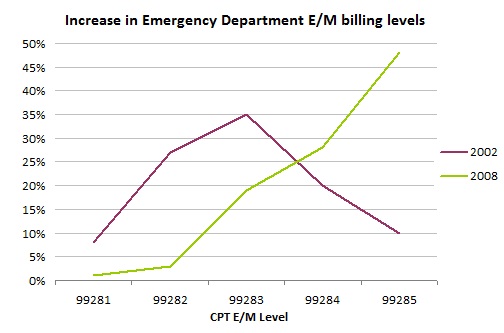
First, from the ED physician reader, a graph showing an increase in overall ED billing levels of 2002 versus 2008:

(E/M level increases, 2002 compared to 2008. Via CMS data; see below. Click to enlarge)


This appears to indicate a great increase in upper level (level 4 and 5) billings from 2002 to 2008 in ED's with increasing advent of EHR (part of this is likely due to "paper template" charting).

A very terse summary of these billing codes, for laypeople. Claims submitted to managed care organizations and States include the emergency levels of screening and treatment. They range from CPT 99281 ("straightforward medical decision making") to CPT 99285 ("medical decision making of high complexity"). These codes reflect not only the complexity of the treatment but also the time and difficulty of making a diagnosis:

  • 99281 - level 1 - very short visit - low level service, minimal charge
  • 99282 - level 2 - e.g. ankle sprain
  • 99283 - level 3 - limited focus history & physical exam performed, e.g. physisian evaluation with additional tests such as an x-ray.
  • 99284 - level 4 - significant history & physical exam performed, significant or major injury, often admission
  • 99825 - level 5 - significant time, e.g., 45 minutes to an hour spent by physician. (Note that considering that a high % of ED visits are using that code, it might be physically impossible for ED physicians to be spending this much time seeing each patient.)


Second, a spreadsheet with some estimated numbers:


(Click to enlarge)


There appears to be an absolute increase in Medicare/Medicaid payments to ER doctors due to this billing-upcoding phenomenon from 2002 to 2008 (roughly $2 billion in payments, which at 80% allowed Medicare rate represents appx. a $2.6 Billion increase in billing)

The 2006-2008 billing levels for each specialty are public info on the CMS website. The hard part was obtaining earlier numbers. These were found in 2 papers from 2004 and 2006:

Variation in Coding of Evaluation and Management (E&M) Services by Hospital Emergency Departments
Paul Shoemaker, FACHE, President and CEO
American Hospital Directory, Inc.
Jan. 2004
http://www.ahd.com/EMstudy040108.pdf


Variations and Trends in the Coding of Evaluation and Management (E&M) Services by Hospital Emergency Departments
Paul Shoemaker, FACHE
Leatrice Ford RN, BSN, CCS, Founder, ConsultCare Partners, LLC
May 2006
http://www.ahd.com/EMstudy060530.pdf

Apparently Shoemaker and Ford were able to get CMS data for 2002 and 2004 and draw the conclusions that while some hospitals and ER groups were undercoding, there was a significant level of upcoding occurring.

Note that the above projections assume the same Medicare physician allowables for 2002 and 2008; lesser values in 2002 (compared to 2008) would push the 2008 payment increases upward.

Finally, some actual ED screens from a major HIT vendor, McKesson, that "encourage" physicians to upcode.

The "coding engine" of this ED EHR system produces "recommendations" for "additional documentation" to support a higher level of coding. Such incentives themselves might be legitimate, but can create moral hazard - and the means, motive and opportunity for "playing with the coding a little bit" - if physicians' coding levels are monitored by their organizations.


(Click to enlarge. An abscess. ED EHR advising physician to "provide more documentation" in order to upcode from level 2 based on the data entered, to level 5 or maximum, via unknown algorithms. A "Correct Deficiencies" button brings up screens with selections a physician can click on to "support" the cybernetic upcoding.)


(Click to enlarge. In this example an ED physician is begin cybernetically cajoled - uh, "reminded" - to enter data to support upcoding a sprained ankle evaluation from a level 3 to a level 5.)


It should be remembered that increased ED coding levels by ED groups, often contractors to hospitals, may permit hospitals to increase their own billing charges for services rendered to the ED patients.

In summary:

  • With little solid evidence of major clinical benefit, ED physicians seem to be paradoxically "asked" to utilize distracting, often mission hostile, even hateful ED EHR systems that many despise, even in face of the critical nature of an ED environment and increased risks and liabilities that can occur with distractions such as data entry. This is a seeming paradox.
  • The ED physicians, after automated coding algorithms analyze the clinical data entered, may be "reminded" that if they fill in a few more details, the visit might be significantly upcoded.
  • Payers such as CMS have little or no way to ascertain the veracity of the additional entered information that may result.
  • The ED physicians' coding levels may be monitored by their employer(s) i.e., group or hospital compared to the "possible" coding levels suggested by the vendor software algorithms. ED EHR software makes this easy. This would create the means, motive and opportunity for upcoding, so as to prevent negative repercussions on a "low coding" doctor. (The ED physician who submitted this data claims that this is so in his organization, and in others.)
While the above is not a rigorous analysis, if it overall reflects the current situation with ED and other EHR's in the field in 2011, we may be seeing:

  • A significant explanation for "irrational exuberance" around health IT - which would actually not be so irrational after all (just unethical) - with potentially deadly results;
  • A highly systematic, major fraud participated in by major stakeholders, from software vendor to purchaser to clinical user to biller. This would represent a cybernetically-facilitated swindle of major (and growing) proportions; and
  • Claims of purported savings from health IT that we hear about from pundits and government officials being a rather pathetic joke.

Perhaps CMS (and other payers as well) could perform the needed rigorous investigation using their data and resources, to either confirm or disprove these findings. That's what we, the taxpayer, pay the government for.

-- SS

The University of Minnesota, Where Nothing Can Go Wrong, Go Wrong, Go Wrong...

As noted on the Periodic Table blog, the administration of the University of Minnesota continues to believe all is well with its clinical research activities.  A recent internal review said there was nothing more to investigate about the unfortunate death of a psychiatric patient years before. So should we all be relieved?

It will take an extensive review of the case to ultimately suggest we should not at all be relieved.  The case raised important concerns about the validity of clinical research, and whether it violates the trust of its patient-subjects.  These concerns had not been addressed before the university's most recent review, and thus seem even more pointed after its recent non-investigation.

Background: the Untimely Death of Dan Markingson

In May, 2008, the (Minnesota) Pioneer Press ran a series of articles about the untimely death of Dan Markingson which occurred while he was enrolled in a randomized trial sponsored by AstraZeneca (the CAFE study) at a site at the University of Minnesota.  The first article in the series made the following major points:

Mr Markingson had given his consent to be enrolled despite evidence that he was actively psychotic
He started having visions of killing his mother in the storm. Markingson was taken Nov. 12, 2003, to Regions Hospital in St. Paul, but it had no open psychiatric beds. He was then transferred to the University of Minnesota Medical Center, Fairview.

Weiss said discussions about research started right away at the hospital. Markingson was placed in Fairview's Station 12, a new unit at the time created to treat psychotic patients and screen them for research. Olson and Dr. Charles Schulz, head of the U's psychiatry department, helped launch the unit in part to enhance the hospital's startup schizophrenia program and meet the U's mandate to bring in more research dollars.

Olson first recommended on Nov. 14 that a Dakota County District Court commit Markingson to the state treatment center in Anoka because he was not fit to make decisions about his care. He wrote to the court that Markingson was convinced his delusions were real and that he wasn't mentally ill.

The doctor changed his opinion about the commitment in less than a week, telling the court Markingson had started to acknowledge the need for help.

Reversals by patients are common, Olson explained in an interview with the Pioneer Press last month. Schizophrenics often arrive for treatment with delusions and denial but change their outlook while hospitalized.

A judge agreed Nov. 20 with Olson's new recommendation, requiring Markingson to follow the doctor's treatment plan. The next day, Markingson signed a consent form to be part of a national anti-psychotic drug study, Comparison of Atypicals for First Episode, or CAFE.

His mother's multiple complaints that while in the study, Markingson was not getting better and not getting proper treatment were ignored
Weiss' letters to Olson and Schulz, who was a co-investigator in the study, urged them to consider different treatment options for her son, which would have disqualified him from the study. But the doctors were unconvinced by her pleas.

In particular, she wrote with strange prescience,
'Do we have to wait until he kills himself or someone else,' she asked three weeks before his suicide, 'before anyone does anything.'
There was evidence that Markingson was not getting optimal treatment

In retrospect, it was not even clear that Markingson was taking his study medications prior to his suicide:
An autopsy showed no medication in Markingson's bloodstream, and a coroner's photo showed a sealed bottle of his medication. Had he been taking his drugs?

Study officials could have been fooled. They only counted drugs left in pill bottles instead of testing blood levels in patients.
Suggestions that financial conflicts of interest influenced trial investigators' actions

The initial news article raised questions whether the study investigator had been unduly influenced to keep Markingson in the study by financial concerns:
CAFE was an early opportunity at the U for Olson to add research experience to his academic credentials. The U had recruited him in 2001 for his expertise in schizophrenia.

It was a slow start. Olson recruited one patient in 2002, and CAFE study leaders considered dropping him altogether, according to monthly recruiting summaries. Olson and the university had been dropped from a previous study because of low recruiting numbers, the doctor later said in his court deposition.

Exchanges between local and national study officials made it clear that there was pressure for results and a 'risk' that the study would be shut down if it didn't recruit enough patients.

Note that:
As Subject 13, Markingson was worth $15,000 to the U, with some of that going to Olson's salary and the psychiatry department. Switching or adding medications could have disqualified Markingson and halted payments to Olson and the department from AstraZeneca.

Overall, the study offered $327,000 to the U and an opportunity to raise the profile of its schizophrenia program.

An accompanying Pioneer Press article indicated that both Dr Olson, and the Chair of Psychiatry, Dr S Charles Schulz, were receiving considerable financial support from AstraZeneca and other pharmaceutical companies at the time of the study.
Olson received $220,000 from six companies since 2002, including $149,000 from AstraZeneca, according to the state records. Schulz received $562,000, including $112,000 as a researcher and consultant to AstraZeneca.

Olson said his AstraZeneca money went straight to the U but did support his salary. Markingson's full participation in the yearlong study meant up to $15,000 for the university.
Did the lawsuit's results indicate nothing was wrong?

Mr Markingson's mother sued the University of Minnesota and AstraZeneca, but (per the first Pioneer Press article),
The lawsuit ended this year after a judge ruled that the university had statutory immunity from such lawsuits and that AstraZeneca shouldn't stand trial because there was no convincing proof that its drug caused Markingson's death. Weiss settled with Olson, the only defendant left. She said she was granted $75,000, which went entirely toward legal bills.
Note that the results did not address the university's or its administration's role.

Dr Carl Elliott Takes Another Look

Thus the case appeared to end, with no real reconsideration of how medical schools' dependence on commercial funding of clinical studies, and how individual faculty members' financial relationships with drug, device, and biotechnology firms may affect research done on human beings.

However, in September, 2010, Mother Jones published an article by Dr Carl Elliott, a University of Minnesota bioethicist, which raised further questions about the case.
I talked to several university colleagues and administrators, trying to learn what had happened. Many of them dismissed the story as slanted and incomplete. Yet the more I examined the medical and court records, the more I became convinced that the problem was worse than the Pioneer Press had reported. The danger lies not just in the particular circumstances that led to Dan's death, but in a system of clinical research that has been thoroughly co-opted by market forces, so that many studies have become little more than covert instruments for promoting drugs

Major design defects of the CAFE study:
It barred subjects from being taken off their assigned drug; it didn't allow them to be switched to another drug if their assigned drug was not working; and it restricted the number of additional drugs subjects could be given to manage side effects and symptoms such as depression, anxiety, or agitation. Like many clinical trials, the study was also randomized and double-blinded: Subjects were assigned a drug randomly by a computer, and neither the subjects nor the researchers knew which drug it was. These restrictions meant that subjects in the CAFE study had fewer therapeutic options than they would have had outside the study.

In fact, the CAFE study also contained a serious oversight that, if corrected, would have prevented patients like Dan from being enrolled. Like other patients with schizophrenia, patients experiencing their first psychotic episode are at higher risk of killing themselves or other people. For this reason, most studies of antipsychotic drugs specifically bar researchers from recruiting patients at risk of violence or suicide, for fear that they might kill themselves or someone else during the study. Conveniently, however, the CAFE study only prohibited patients at risk of suicide, not homicide. This meant that Dan—who had threatened to slit his mother's throat, but had not threatened to harm himself—was a legitimate target for recruitment.

As Dr Elliott noted, this appeared to be yet another example of manipulation of clinical research designed to make the sponsors' products look better, a topic we have frequently discussed on Health Care Renewal:
A 2006 study in The American Journal of Psychiatry, which looked at 32 head-to-head trials of atypicals, found that 90 percent of them came out positively for whichever company had designed and financed the trial. This startling result was not a matter of selective publication. The companies had simply designed the studies in a way that virtually ensured their own drugs would come out ahead—for instance, by dosing the competing drugs too low to be effective, or so high that they would produce damaging side effects. Much of this manipulation came from biased statistical analyses and rigged trial designs of such complexity that outside reviewers were unable to spot them. As Dr. Richard Smith, the former editor of the British Medical Journal, has pointed out, 'The companies seem to get the results they want not by fiddling the results, which would be far too crude and possibly detectable by peer review, but rather by asking the 'right' questions.'

This was likely what was going on with the CAFE study:
Although the documents unsealed in the Seroquel litigation do not specifically mention the CAFE study in which Dan was enrolled, they do suggest that AstraZeneca planned to establish Seroquel as the "atypical of choice in first-episode schizophrenia,' according to a 2000 'Seroquel Strate'y Summary.' A later document titled 'Seroquel PR Plan 2001' discusses the agenda for an advisory panel meeting in Hawaii. Among the potential topics were the marketing of Seroquel to first-episode patients, adolescents, and the elderly. The document refers to these populations as "vulnerable patient groups."

Even more alarming are internal documents suggesting that AstraZeneca was designing clinical trials as a covert method of marketing Seroquel. In 1997, when Dr. Andrew Goudie, a psychopharmacologist at the University of Liverpool, asked AstraZeneca to fund a research study he was planning, a company official replied that 'R&D is no longer responsible for Seroquel research—it is now the responsibility of Sales and Marketing.' The official also noted that funding decisions would depend on whether the study was likely to show a 'competitive advantage for Seroquel.'
Were study subjects protected?
So, as Dr Elliott wrote,
Many clinical studies place human subjects at risk—at a minimum, the risk of mild discomfort, and at worst, the risk of serious pain and death. Bioethicists and regulators spend a lot of time and energy debating the degree of risk that ought to be permitted in a study, how those risks should be presented to subjects, and the way those risks should be balanced against the potential benefits a subject might receive. What is simply assumed, without much consideration at all, is that the research is being conducted to produce scientific knowledge. This assumption is codified in a number of foundational ethics documents, such as the Nuremberg Code, which was instituted following Nazi experiments on concentration camp victims. The Nuremberg Code stipulates that an 'experiment should be such as to yield fruitful results for the good of society,' and 'the degree of risk to be taken should never exceed that determined by the humanitarian importance of the problem to be solved by the experiment.'

But what if a research study is not really aimed at producing genuine scientific knowledge at all? The documents emerging in litigation suggest that pharmaceutical companies are designing, analyzing, and publishing trials primarily as a way of positioning their drugs in the marketplace. This raises a question unconsidered in any current code of research ethics. How much risk to human subjects is justified in a study whose principal aim is to 'generate commercially attractive messages'?

Conflicts of interest
Of course, university faculty pushed to bring in more external funds to support their careers (see this post) by university leaders with their eyes on the bottom line may not be too critical of the intricate designs of the studies they need to do to continue their academic careers, and whether such studies are really meant to promote science and improve patient care, or position products in the marketplace, especially when the same companies are paying them as consultants, speakers, etc.

In fact, Dr Elliott found reasons to make such concerns specific to the case of Mr Markingson's untimely death:
Olson had another financial reason to maintain good relations with AstraZeneca. According to a disclosure statement for a 2006 conference, he was a member of the AstraZeneca 'speaker's bureau,' giving paid talks for the company. He had similar arrangements with Eli Lilly and Janssen, the makers of the other atypicals being tested in the CAFE study, as well as Bristol-Myers Squibb and Pfizer. In addition, Olson was working as a paid consultant for Lilly, Janssen, Bristol-Myers Squibb, and Pfizer.

Bioethicists Demand an Investigation

So eight University of Minnesota bioethicists, including Dr Elliott, wrote a letter to the University administration demanding an investigation, as reported in December, 2010, by the Minneapolis- St Paul Star-Tribune,
In a letter to the board Monday, the professors questioned whether U psychiatrists lacked ethical judgment in enrolling the victim, Dan Markingson, a schizophrenic who may have lacked the wherewithal to consent to research. They also questioned whether financial incentives from AstraZeneca, the drugmaker funding the study, presented conflicts for the researchers, Dr. Stephen Olson and Dr. S. Charles Schulz.

At the time, the administration promised a serious response:
U leaders will take the letter seriously and take the protection of human research subjects seriously, said the U's general counsel, Mark Rotenberg.

But then almost immediately indicated its bias:
'The fact that this is tragic doesn't mean the treating physicians did anything wrong,' he said.

What, Us Worry?

It did not take long for Mark Rotenberg to decide that there was nothing more to worry about. As reported in February, 2011, by the Pioneer Press:
in a Monday letter to Elliott and colleagues, the chairman of the U's board of regents wrote 'we do not believe further university resources should be expended re-reviewing a matter such as this, which has already received such exhaustive analysis by independent authoritative bodies.'

'Our general counsel has provided us with the extensive reviews of this case that were performed over the years by a number of independent experts and governmental units,' chairman Clyde Allen Jr. said in the letter. 'Each and every one of these reviews resulted in the same conclusion: there was no improper or inappropriate care provided to Mr. Markingson, nor is there evidence of misconduct or violation of applicable laws or regulations.'

Of course, since Mr Rotenberg is responsible for, among other things, reducing the university's legal liability, one could see how he might not want to delve further into this case.  As we noted earlier, it is not clear that previous "exhaustive" investigations asked the questions that needed to be asked, or had access to all the relevant data.  The issues are not whether their was criminal conduct, or even civil liability, but whether the university is presiding over good science and protection of research subjects?

So we should be worried, of course, that commercial firms sponsor research on human beings mainly to serve marketing objectives, and that university faculty and administrators go along, allowing their formerly prestigious universities' names to be added to the research in exchange for the money they so much want to keep themselves living in the style to which they are accustomed. We ought to be particularly worried when these universities seem to forget about their mission to find and disseminate new knowledge in favor of defending the work that continues to bring in the money.

Thus, physicians, researchers, patients, and the public ought to be very skeptical about clinical research sponsored by commercial firms with vested interests in the research turning out a particular way, and even about research not sponsored by such firms, but done by researchers who have personal financial ties to such firms. Worse, patients ought to be extremely skeptical about the motives of researchers who want to enroll them in trials when the researchers have financial ties to commercial firms whose products could be promoted through such trials, and especially when such firms are sponsoring the trials.

As a long-time advocate for evidence-based medicine, whose advancement depends on the continuing creation of valid research evidence from clinical research, it is heart-breaking to have to make these recommendations, but they will be necessary until there is better assurance that clinical research is being done to advance science and patient care, not the commercial interests of the sponsors and the researchers.

Until academic medicine becomes more open about how and why it is doing clinical research, such skepticism is warranted.

However, I will end with a ray of hope. If the administrators and faculty do not get it, the student journalists do. Read these words in an editorial in the Minnesota Daily:
Of course, the University has maintained neither it nor anyone involved in the case did anything wrong, an odd claim to make after the Minnesota Legislature unanimously passed a law that prohibits exactly what happened and named the law after Markingson.

The University seems to think that because it was not held liable in court for Markingson’s death, it did nothing wrong. This is false; it is a cynical excuse to keep corporate drug money flowing into the University.

The regents’ decision fundamentally undermines our mission: Supposedly, the University is 'dedicated to … the search for truth.' But the letter makes it clear that corporate research cash is more important to the University than patient safety and transparency.

Refusing to set up an independent investigation is a willfully ignorant attempt to sweep the Markingson case under the rug and damages the integrity of the entire University.

Perhaps it is time for the state legislature to take another look at this issue.

True health care reform would separate clinical research, that is, research done on human beings, from the commercial interests of health care corporations and the people who work for them.

ADDENDUM (18 March, 2011) - See this post by Naomi Freundlich on the Health Beat blog.

Monday, February 14, 2011

"You Can't Say That" - Non-Disparagement Clauses and the Anechoic Effect

Here is another example of why health care organizations' leaders are different from you and me, and why that may not be a good thing for health care.  A few days ago, the San Jose (California) Mercury News reported on the upcoming departure of a local hospital CEO:
El Camino Hospital's handsomely-paid president and CEO Kenneth Graham is out of a job, the hospital announced Thursday afternoon.

Graham's contract will end June 30 'without cause, at the request of the hospital's Board of Directors,' according to a statement released to the media.

Until then, Graham will continue to fulfill his duties as the hospital's top administrator, according to the statement. Graham has been president and CEO of the hospital for 4½ years.

The brief statement did not explain why Graham has been ousted, focusing instead on his accomplishments. Graham earns an annual base salary of $632,640.

Not only was the CEO "handsomely paid," he will be handsomely paid to depart, as reported two days later by the same newspaper:
Former El Camino Hospital president and CEO Ken Graham may be out of a job, but he won't be hurting for a paycheck anytime soon.

Fired 'without cause' by the hospital's board of directors on Wednesday, Graham is now entitled to nearly $1 million in severance pay, according to his contract, which the hospital provided to The Daily News on Friday.

Specifically, the hospital will pay Graham a lump sum of 18 months' salary when he officially steps down June 30. Based on his annual salary of $632,640, he would receive $948,960.

The reporter could not get any clearer fix on the reason for his departure:
Hospital officials Friday were tight-lipped about their decision to drop Graham. Reached by phone, board Chairman Wesley Alles would only say it was 'without cause.'

'I guess as a generic (explanation) the only thing I can say is it's without cause, that (the board wants to take) some different directions, perhaps, as a generic (explanation),' Alles said.

El Camino Hospital spokeswoman Chris Ernst said she couldn't say more than what was written in a statement released to the media Thursday, which simply stated Graham's contract was ended 'without cause, at the request of the hospital's Board of Directors.'

'I know everyone wants to know if there's something really there, but it was clearly without cause,' Ernst said. 'It's not like you can point to one particular thing and say this is why this action was taken.'

Now wasn't that informative? It appears the CEO was let go "without cause." But reporter Diana Samuels did uncover why nobody was saying anything meaningful about this lucrative departure:
The contract also includes a 'non-disparagement' clause, which says the hospital and Graham cannot make any statements about each other that could cause 'any embarrassment or humiliation or otherwise reflect negatively on the other party(ies).'

I discussed the subject of executive contracts with one of our Health Care Renewal scouts who knows about such things. For high level executives in business, seemingly tidy severance packages are the rule.  We have discussed the problem with excess executive compensation in health care here.

Furthermore, various confidentiality, non-compete, and non-disparagement clauses are often common.

However, whether or not these are common practices in the larger business world, these contract provisions, especially non-disparagement clauses, pose problems in health care.  As we have discussed, there are lots of good reasons that the governance and leadership of health care ought to be maximally transparent.

Just to provide one example, consider the problem of medical errors, a subject which has received unending discussion since the report by Institute of Medicine entitled "To Err is Human."  One widely espoused doctrine about medical error prevention is that such errors ought to be disclosed and discussed openly so that their root causes can be found, and methods to prevent them developed.  Now suppose, for example, that the CEO of a hospital had discovered some medical errors, but made himself unpopular by pursuing them.  Were he to have a bilateral non-disparagement clause in his contract, and were this unpopularity to cause him to lose his job, he could say nothing about these errors, possibly allowing them to recur, but more seriously.  Of course, the example could be turned on its head.  Suppose the CEO had introduced a new process that was thought to be the cause of such errors.  Were he to lose his job because of this, hospital officials could say nothing about the problem, etc, etc.  Similarly, other problems at the hospital either discovered by the CEO or possibly caused by the CEO could remain anechoic due to non-disparagement clauses in hospital executives' contracts.

Of course, in the current case, the CEO might have left due to simple personality differences, and his departure might have nothing to do with medical errors, etc, etc.

However, this case suggests that the sort of non-disparagement clauses that may appear in contracts for executives in various type of businesses have metastasized to contracts for hospital executives.  These clauses, and their cousins, confidentiality clauses and non-compete clauses, may be major reasons for the anechoic effect, and the general lack of transparency of hospital leadership and governance. 

However, up to now, such clauses seem to be, you guessed it, anechoic in discussions of health care policy and health care reform. 

Thus, one step to true health care reform would be for there to be some open discussion of the reasons we cannot openly discuss many important issues in health care, particularly the likely increasing use of contractual clauses such as non-disparagement clauses.  Likely an even more important step would be discrediting such contractual provisions that reduce transparency.

Friday, February 11, 2011

Why Weren't Existing Laws About Hospital CEO Compensation Enforced in Washington State?

Public radio station KUOW reported on the generous compensation given hospital CEOs in Washington:
KUOW has learned that 15 hospital executives in Washington made $1 million or more in 2009. That elite group includes 14 nonprofit executives and one head of a government hospital. CEOs at Multicare, Providence, Virginia Mason and Valley Medical each made more than $2 million.

Those numbers can be found in the hospitals' latest tax filings and other public records. The pattern was more lopsided in the two prior years. Nobody working at a public hospital cracked the top 10 list of the state's highest hospital paychecks in 2007 or 2008.

But then the story takes an interesting twist:
Most of Washington's largest hospitals are nonprofit organizations. The state gives the nonprofits a break on their business taxes to help reduce the cost of health care.

The hospitals have to jump through some hoops to qualify for the reduced taxes. For one thing, state law limits how much the hospitals can pay their executives. Their pay has to be comparable to what public servants in Washington make in similar jobs — or else no break on their B&O taxes.

Somehow everyone seems to have forgotten about this part of the law:
The limit on executive pay has been on the law books for 30 years.

Gowrylow: 'Frankly, I don't think it's something that's been on our radar since the mid–80s.'

Mike Gowrylow is a spokesman for the Washington Department of Revenue. He says the recent million–dollar incomes were news to the department.

Gowrylow: 'But it's certainly something that I think we need to take a look at again and examine whether these nonprofits are paying their executives excessively or not.'

Gowrylow says the agency only audits 2 or 3 percent of tax returns. It mostly relies on businesses to comply voluntarily with the state's tax laws.

Gowrylow: 'We can't be everywhere. If we become aware of a nonprofit or any other business that's underreporting their taxes, we investigate those complaints, and if tax is due, we will assess it.'

He says the agency can recover back taxes for the past four years, along with penalties and interest.
Although the article cited an unsuccessful legal action to enforce the law in a particular case in 1986, why the state government seemed to forget about it after that is unclear, and maybe deserving of further investigation.
Right  now, hospital management seems to be trying to avoid the issue, or is arguing about the meaning of "comparable,"
Several present day hospital officials declined to be interviewed on tape. They told KUOW they believe they are in compliance with the state law. But they generally provided little detail to back up that claim.

Providence and Group Health representatives both said their organizations are so large and complex that there may not be any comparable public service jobs in Washington.

Swedish spokeswoman Melissa Tizon told me that CEO Rodney Hochman's pay was generally comparable to what the highest paid public hospital executives made, at Valley and Evergreen hospitals.

On the other hand,
Harborview is the state's largest hospital. Eileen Whalen is its head and an employee of the University of Washington. She makes about $470,000.

[State Senator Karen] Keiser: 'That's really not comparable to the million dollar and more salaries of other hospital directors in our state. We are paying attention here in Olympia to that.'

Other executives at UW Medicine did make more than Whalen. Still, none of them, not even the president of UW, made as much as any of the 15 highest paid executives at nonprofit hospitals in 2009.

I searched high and low to find any public officials making as much as the top nonprofit CEOs.

The only one I found who consistently did so was the UW football coach. But it might be hard to argue that Steve Sarkisian's job is comparable to running a hospital system.

We have discussed numerous cases of executives of not-for-profit hospitals and hospital systems receiving lavish compensation and benefits that seem out of proportion to any reasonable measure of their performance or of their positions' difficulties.  (Remember that advocates of corpulent executive compensation love to cite the size of the company and the number of employees, but the CEO really has only to manage the next tier of executives, rarely numbering more than a dozen.)

As we have said before, far too often the leaders of not-for-profit health care institutions seem more interested in padding their own bottom lines than upholding the institutions' missions. They often seem entirely unaware of their duty to put those missions ahead of their own self-interest. Like the financial services sector in the era of "greed is good," health care too often seems run by "insiders hijacking established institutions for their personal benefit." True health care reform would encourage leadership of health care who understand health care and care about its mission, rather than those who see a quick way to make a small fortune.

However, the twist in this story is that it appears the lavish compensation of hospital executives in this particular state may have violated state law, or at least the tax breaks these hospitals got may have violated the law, given their leaders excessive compensation, and that the law in question is over 30 years old.  However, the law seems to have been forgotten or ignored for nearly all that time, for reasons that are unclear. 

This seems reminiscent of how the Responsible Corporate Officers' Doctrine seems to have been forgotten and ignored.  this post from June, 2010).  However, in the last 30+ years, this notion has been ignored and abandoned by US government regulators at least in so far as it applies to health care organizations, particularly drug, biotechnology and device companies.

The big question is why have such laws and legal practices, which have not been repealed or refuted, instead been ignored and forgotten?  Surely this cries out for investigation.

Of course, It seems that somehow in the brave new world of laissez faire, anything goes capitalism foisted on health care over the last 30 plus years, old practices and customs that limited the power and enrichment of top leaders may have seemed increasingly prudish, and those advocating them may have seemed to be old fuddy duddies to those bent on personal gain.  But unhipness and scorn of prudishness are not reasons to ignore an existing law. 

So it is not that there are no legal tools to prevent abuses by leaders of health care organizations.  Instead, there has been increasing forgetfulness of the existence of such tools, and perhaps a growing effeteness of enforcement that has lead to a reluctance to even try to use them.  So we can start truly reforming health care by simply enforcing the laws that are already there. 
  

Thursday, February 10, 2011

Passport to ... Fraud? - AmeriHealth Mercy Settles

Back in November, 2010, we discussed the relatively opulent pay and perks given to and conflicts of interest affecting leaders of Passport Health Plan, a non-profit, state (Kentucky) supported Medicaid managed care organization/ health insurer.  This seemed to be another case of health care organizational insiders putting their personal gain ahead of their mission, which was particularly unseemly because their mission was serving the poor. 

Now Passport Health is in the news again, and not in a favorable way, as per the Louisville (Kentucky) Courier-Journal:
Passport Health Plan’s main contractor has agreed to pay more than $2 million in damages to the Kentucky Medicaid program to settle a fraud investigation, Attorney General Jack Conway announced Wednesday.

The settlement with AmeriHealth Mercy Plan is the result of a nine-month investigation by the Attorney General's Medicaid Fraud Unit into alleged falsification of records by the company that entitled it to more than $677,000 in bonus money for good performance.

Conway said the investigation centered on an allegation from a whistleblower that AmeriHealth falsely reported data to the state Medicaid Services Department on the number of Medicaid recipients who received cervical cancer screenings in 2009. The false numbers allowed AmeriHealth to receive the bonus money under the terms of its contract.

We have discussed a variety of cases of leaders of health care organizations getting compensation or benefits that seemed disproportionate in their organizations' context. The usual justification seems to be that it takes such rewards to attract the excellent leaders needed by health care organization.

Here is another example of leaders who not only seemed to get excessive compensation and benefits, but whose performance seemed far from excellent.

Moreover, it suggests that compensation and benefits may actually have an inverse correlation to performance. Organizations whose stewards seem unrealistic about the talents of their hired managers, and dependent on material rewards to retain such managers may lack good stewardship. Leaders who find themselves rewarded beyond any reasonable evaluation of their work may learn the lesson that they cannot ask for too much. Meanwhile, the excess of their rewards may inspire increasing greed rather than increasing devotion to the mission, while the pay and perks increasingly place them in a bubble that insulates from the concerns of the common people who their organizations are supposed to serve.

As we have said before, far too often the leaders of not-for-profit health care institutions seem more interested in padding their own bottom lines than upholding the institutions' missions. They often seem entirely unaware of their duty to put those missions ahead of their own self-interest. Like the financial services sector in the era of "greed is good," health care too often seems run by "insiders hijacking established institutions for their personal benefit." True health care reform would encourage leadership of health care who understand health care and care about its mission, rather than those who see a quick way to make a small fortune.

PS - Also note that this is also another example of the sort of legal settlements of misbehavior by health care organizations that seems to have little deterrent effect, mainly because no individual who authorized, directed or implemented the bad behavior suffers any negative consequences.  See our discussion in these previous posts.  True health care reform would also hold leaders accountable for their organizations' misdeeds.

Tuesday, February 08, 2011

After Publicity About Losses from Corruption, Now Will Any Health Charities Start Anti-Corruption Initiatives?

Over the last few weeks a series of stories appeared about how corruption siphons off money from worthy global health initiatives. 

Corruption Depletes Global Fund to Fight AIDS, Tuberculosis and Malaria

The story that first got attention was from AP:
A $21.7 billion development fund backed by celebrities and hailed as an alternative to the bureaucracy of the United Nations sees as much as two-thirds of some grants eaten up by corruption, The Associated Press has learned.

Much of the money is accounted for with forged documents or improper bookkeeping, indicating it was pocketed, investigators for the Global Fund to Fight AIDS, Tuberculosis and Malaria say. Donated prescription drugs wind up being sold on the black market.

The fund's newly reinforced inspector general's office, which uncovered the corruption, can't give an overall accounting because it has examined only a tiny fraction of the $10 billion that the fund has spent since its creation in 2002. But the levels of corruption in the grants they have audited so far are astonishing.

A full 67 percent of money spent on an anti-AIDS program in Mauritania was misspent, the investigators told the fund's board of directors. So did 36 percent of the money spent on a program in Mali to fight tuberculosis and malaria, and 30 percent of grants to Djibouti.

In Zambia, where $3.5 million in spending was undocumented and one accountant pilfered $104,130, the fund decided the nation's health ministry simply couldn't manage the grants and put the United Nations in charge of them. The fund is trying to recover $7 million in 'unsupported and ineligible costs' from the ministry.

The fund is pulling or suspending grants from nations where corruption is found, and demanding recipients return millions of dollars of misspent money.

'The messenger is being shot to some extent,' fund spokesman Jon Liden said. 'We would contend that we do not have any corruption problems that are significantly different in scale or nature to any other international financing institution.'

To date, the United States, the European Union and other major donors have pledged $21.7 to the fund, the dominant financier of efforts to fight the three diseases. The fund has been a darling of the power set that will hold the World Economic Forum in the Swiss mountain village of Davos this week.

It was on the sidelines of Davos that rock star Bono launched a new global brand, (Product) Red, which donates a large share of profits to the Global Fund. Other prominent backers include former U.N. secretary-general Kofi Annan, French first lady Carla Bruni-Sarkozy and Microsoft founder Bill Gates, whose Bill and Melinda Gates Foundation gives $150 million a year.
Corruption Depletes Health Alliance International

At about the same time, the Seattle Times reported fraud losses at another global health project:
Health Alliance International (HAI), which was begun in 1987 by North American doctors and nurses to support the fledgling government in Mozambique, has played a leading role in HIV treatment.
Focused on strengthening health systems of impoverished and fragile nations, it was awarded the Doris Duke Charitable Foundation's Africa Health Initiative grant, a seven-year $10 million program to help government-run health facilities use data to improve services. The UW departments of Global Health and Industrial Engineering are partners in that project.

All but 7 percent of its funding came from the U.S. government, and more than 90 percent of its work was in Mozambique, according to HAI's 2009 annual report. Gloyd said the alliance increased the number of people receiving antiretroviral drugs from about a couple dozen in 2003 to more than 50,000 this year.

In late 2009, the alliance applied for what would have been its biggest grant ever — $100 million in funding from USAID over the next five years.

Early last year, its application was selected as the best technical proposal. But in the midst of the administrative review in June, a tipster reported problems in an organization employed by HAI.

One such program hired local community organizations in Mozambique for home-based nursing care and delivery of basic medical kits. The alliance did an internal audit and discovered irregularities.

'Their own accounting for those kits was quite inadequate, and that came back to bite us,' Gloyd said.

HAI shared the findings with USAID and put forth a plan to resolve the issues. But at the end of August, USAID rejected the group's grant application.
How Big Is Corruption?
There was actually considerable dispute about the significance of the fraud discovered at the Global Fund. On one hand, the losses were a very large proportion of the grants investigated. On the other hand, the total amounts were a very tiny proportion of the total of the fund's outlays. As summarized by William Savedoff in the Center for Global Development's Global Health Policy blog:
While readers might finish the AP article mistakenly thinking that $14 billion has been stolen (that is, two-thirds of $21.7 billion), it would also be a mistake to read the Global Fund press release and believe that only $34 million is gone.

What we’re missing is a way to assess how representative these cases may be. If the Global Fund’s detection system is 100% effective, then these cases are isolated and it is a tiny problem. If the detection system only picks up 50% of cases, then instead of a tiny problem, we’ve got a small one. But if the detection system only finds 5% of cases then—despite the mistaken deduction from the AP article—we really would have a massive billion-dollar corruption problem.

The Global Fund should be praised, not slammed, for its investigations and for its openness. But, it also needs to be challenged to find a way to estimate how representative these cases may be.

At any case, the Global Fund has promised "new anti-corruption measures," per the AP again.
A $21.7 billion global health fund and the U.N.'s main development arm launched new anti-corruption measures Friday in the wake of intense scrutiny from donors and stories by The Associated Press detailing fraud in their grants.

Chief among The Global Fund to Fight AIDS, Tuberculosis and Malaria's new measures are plans to create a high-profile panel of experts to examine the fund's ability to prevent and detect fraud in its grants.

'Programs supported by the fund have saved seven million lives and are turning back the three disease pandemics around the world,' said the fund's executive director, Dr. Michel Kazatchkine. He said the fund has 'zero tolerance' for fraud and corruption and was 'responding aggressively when instances of fraud or misappropriation are detected.'

That is nice, but I submit these stories are a reminder of how anechoic health care corruption is, and how few and ad hoc are the few efforts made to fight it. Much of the coverage of the corruption affecting the Global Fund had a breathless quality as if the authors were shocked, shocked that there could be corruption in health care.

In fact, many people more distinguished than yours truly have been warning about health care corruption for years. In particular, in 2006, Transparency International's Global Corruption Report, asserted in its executive summary, " the scale of corruption is vast in both rich and poor countries."  It also noted how diverse is health care corruption:
In the health sphere corruption encompasses bribery of regulators and medical professionals, manipulation of information on drug trials, the diversion of medicines and supplies, corruption in procurement, and overbilling of insurance companies. It is not limited to abuse by public officials, because society frequently entrusts private actors in health care with important public roles. When hospital administrators, insurers, physicians or pharmaceutical company executives dishonestly enrich themselves, they are not formally abusing a public office, but they are abusing entrusted power and stealing precious resources needed to improve health.

It further stated how serious the consequences of corruption may be:
Corruption deprives people of access to health care and can lead to the wrong treatments being administered. Corruption in the pharmaceutical chain can prove deadly....


The poor are disproportionately affected by corruption in the health sector, as they are less able to afford small bribes for health services that are supposed to be free, or to pay for private alternatives where corruption has depleted public health services.


Corruption affects health policy and spending priorities.

On this blog, our limited resources make us focus mainly on the US, and sometimes other English-speaking countries. Yet we now have in our archives some amazing stories that document various forms of corruption, including numerous allegations of corporate misbehavior ending in legal settlements, outright fraud, and other crime. Also, as we have noted before, the US Institute of Medicine has defined conflicts of interest
Conflicts of interest are defined as circumstances that create a risk that professional judgments or actions regarding a primary interest will be unduly influenced by a secondary interest.

Given that Transparency International's definition of corruption is
abuse of entrusted power for private gain

One can easily argue that in health care, conflicts of interest defined as above create risks of abuse of power by health care professionals influenced by the private gains provided by their secondary interests. On Health Care Renewal, we have provided a massive set of examples of individual and institutional conflicts of interest. There is evidence that about two-thirds of medical academics(1) and academic leaders(2) have significant conflicts of interest. The huge prevalence of conflicts suggests the risk of major corruption.

Corruption and Conflicts of Interest as Anechoic

So what we all should be shocked, shocked about is how little has been done to fight health care corruption, whether in Mozambique or the US.

Note that the Gates Foundation is a major donor to the Global Fund. It has a number of disease or condition specific initiatives, and a global health policy and advocacy initiative. But it has no initiative to fight corruption and conflicts of interest, or, to put it in positive terms, to promote accountability, integrity, transparency, honesty and ethics.

The Doris Duke Charitable Foundation funds Health Alliance International.  It funds medical research, and has a specific focus on African health care research.  However, it also has no initiatives to fight corruption and conflicts of interest, or improve accountability, integrity, transparency, honesty and ethics in health care.

In fact, one could look in vain for any initiatives about or funding for anti-corruption, or pro-accountability, integrity, transparency, honesty and ethics by any major US charity with health care interests.

One can  find very few significant efforts to discuss, teach about, or research ways to fight corruption, or to promote accountability, integrity, transparency, honesty and ethics by academic health care institutions.  (See this post for how difficult it was to find academic institutions' initiatives to resist conflicts of interest.)  One can count the conferences, meetings, symposia, and courses on such topics on one's fingers. When I last looked, I could count only a single course on fighting corruption at any US medical or public health school ( at Boston University, by Prof Taryn Vian).

Given the scope of corruption, we should be shocked, shocked at how anechoic it is, and how our respected health care institutions, particularly academic institutions and health care charities have ignored the problem.

So will the Global Fund's losses to corruption inspire the Gates Foundation or any of its major donors to start an anti-corruption initiative? Or even have an anti-corruption symposium? So will the Health Alliance International's losses so inspire the Doris Duke Charitable Foundation?  Will these cases inspire any foundation, or academic health care organization to do anything to fight corruption and conflicts of interest, and to promote accountability, integrity, transparency, honesty and ethics in health care?

I am not holding my breath, but I live in hope.

Of course, one reason we started Health Care Renewal was to make these issues less anechoic. So hear we go again.

PS - If anyone in our vast audience does know about any additional anti-corruption or conflict of interest, or pro-accountability, integrity, transparency, honesty and ethics initiatives, courses, meetings relevant to health care, please let me know and I will do my best to disseminate the information.

References

1. Campbell EG, Gruen RL, Mountford J et al. A national survey of physician–industry relationships. N Engl J Med 2007; 356:1742-1750. (link here)

2. Campbell EG, Weissman JS, Ehringhaus S et al. Institutional academic-industry relationships. JAMA 2007; 298: 1779-1786. (link here)

Sunday, February 06, 2011

The New Steward Health Care: Will Superbowl Ads and "Leakage Reduction" Keep the Ship Afloat, or Will a "Greater Fool" Be Left Trying to Bail it Out?

Some recent publications raise interesting questions about the leadership of a regional health care organization which now seems to have intentions of going national. 

A Superbowl Ad for Steward Health Care

The millions watching the Superbowl, maybe the biggest single US sports event, expect to be dazzled by the new, extremely expensive advertisements to be aired during the television coverage of the event.  The Boston Globe reported that the glitzy offerings by Volkswagen and Budweiser will have an odd companion, at least in the Boston area:
The local television audience for Super Bowl XLV on Sunday will get the usual array of high-impact commercials, from the suds of Budweiser to the sedans of Kia Motors. But amid all the elaborate productions, one quieter spot might stand out — an ad for Steward Health Care System, the Boston company formed to oversee the six Caritas Christi hospitals.

During the 30-second commercial, Massachusetts residents talk about the importance of quality health care, as the camera roams through Brighton and Dorchester — the homes of St. Elizabeth’s Medical Center and Carney Hospital.

There was no such marketing campaign for the hospitals before November, when they were bought by New York private equity firm Cerberus Capital Management. The ad will be broadcast only on WFXT-TV (Channel 25), not nationally.

Officials at Steward said they were looking to introduce the health care service company to customers who may have never heard of Steward. The campaign also further demonstrates a different marketing approach for the regional hospital network as it transitions to a for-profit health care player.

Why would a hospital system advertise during the Superbowl?
Brian Carty, chief executive marketing officer at Steward, said that’s the aim: make a debut during the Super Bowl to reach a large swath of local consumers.

'You can only launch a brand once, and we wanted to launch it in the biggest way we could,' said Carty.

It certainly is curious, particularly when the brand is only new in the most superficial sense. As noted above, Steward Health Care System is the new name given the former Caritas Christi, a regional Massachusetts health care system that was formerly non-profit and run by the Catholic Church, but was recently bought out by Cerberus Capital Management, a private equity company.

We discussed concerns about whether a private equity group would put its short-term financial gain ahead of the patient care mission if given the chance to run a hospital system in a series of posts in spring, 2010.

A CEO with a Short-Term Focus

Things get curiouser and curiouser. The Boston Globe also just published a lengthy report on former Caritas Christi, now Steward Health Care CEO Ralph De La Torre, which emphasized, perhaps unintentionally, his chronic focus on short-term gain.
[Friend and mentor Dr David] Torchiana has been fielding questions from lots of colleagues wondering what de la Torre might to next. 'My view of Ralph,' he tells them, 'is that he's aggressive and unpredictable.'

Forced Out His BIDMC Chief
Dr de la Torre trained as a cardiovascular thoracic surgeon who apparently was a very highly regarded surgeon. But then, the article described how Dr de la Torre forced out his clinical and academic leader at the Beth Israel Deaconess Medical Center:
He stayed at Boston Medical for only a year, jumping to Beth Israel Deaconess Medical Center for a better opportunity. Dr. Frank Sellke, Beth Israel’s relatively young interim chief of cardiothoracic surgery, saw great things in him.

But then,
After a couple of years, Sellke, who officially became chief in 2001, started hearing chatter that de la Torre was gunning for his job. He didn’t take it seriously. Traditionally, to be a chief at a Harvard-affiliated hospital like Beth Israel, you needed heavy research and teaching credentials, which de la Torre did not have. 'When I heard Ralph was trying to undo me, I thought it was joke,' Sellke says. 'It turns out the joke was on me.'

In 2004, de la Torre greatly expanded his reach when hospital officials named him chief of cardiac surgery, a section within the division of cardiothoracic surgery. Two years later, he gained freer reign over cardiac care after the hospital removed Sellke as chief of the division. Sellke – who stresses that he is happy now as a chief at Brown Medical School and remains one of the country’s best-funded cardiac researchers – says that although he respects de la Torre’s talents, he lost respect for him as a person. 'He has a take-no-prisoners approach. If he interrupts or destroys someone else’s career, that doesn’t bother him in the least.'
Developed CardioVascular Institute, then Left
After this little coup d'etat, Dr de la Torre hatched a plan to integrate cardiovascular care at the BIDMC, but then flew the coop after it did not work out as planned:
Instead, he hatched a plan to revolutionize cardiac care at Beth Israel. Traditionally, cardiac surgeons, vascular surgeons, and cardiologists operated in their own silos, even though they were all treating related cardiovascular diseases. De la Torre proposed the CardioVascular Institute, or CVI, as a way to break down those silos and centralize care by creating a 'hospital within a hospital.'

But,
The CVI officially opened in 2007, with de la Torre as president and CEO. He continued his work as a surgeon, maintaining the salary of more than $1.3 million that he had earned the previous year.

Pomposelli says de la Torre’s enormous talent, intellect, and drive helped the CVI succeed in many ways, notably in removing waste from hospital operations and in building strong networks of affiliated physicians. De la Torre wined and dined community cardiologists around the region, persuading them to become affiliates and refer patients to Beth Israel for care.

But Pomposelli concedes that the CVI fell short in other ways. The silos were harder to break down than they thought, especially since “we didn’t pay enough attention to academics and research.” Also the “enhanced revenues” to physicians turned out to be far less than promised, leading to resentment. Pomposelli, who remains the chief of vascular surgery at Beth Israel, stresses that the CVI still exists, but in a much less ambitious form. 'Ralph’s a builder. He loves the deal, loves creating new things,' Pomposelli says. 'I don’t think he loves managing things as much. Running the CVI turned out to be tedious and difficult.'

And de la Torre was out the door before this idea turned out to be less than what he touted:
In 2008, just a year after seeing his brainchild become a reality, de la Torre told Pomposelli he would be leaving to run the ailing Caritas hospital network.
Left Republican Party, Became Democrat

After assuming control of Caritas, Dr de la Torre seemed to abandon his previous political affilisations.
As recently as 2007, he was a registered Republican.

De la Torre (pronounced DEL-a-TOR-ree) says that, like many children of Cuban immigrants, he has long identified with the conservative Republican outlook on foreign policy, though he is a social liberal. Sometime after he moved to Newton, he switched his registration to independent. Regardless, he stresses that he was not politically active until recently, when he became motivated to fund Democratic candidates because of that party’s commitment to overhauling health care.

Then, the instant Democrat contributed substantially to the campaign of Massachusetts Attorney General Martha Coakley, who had to approve the take-over by Cerberus of Caritas:
she was the guest of honor at a ... fund-raiser held at the de la Torre home the previous fall when she was running for US Senate.

Some state Republicans complained that Coakley should not have been signing off on a deal being advanced by a major campaign donor, although they could produce no evidence that her office’s review was anything but thorough and deliberative.

And he hosted a better noticed fundraiser that that included a visit by President Obama,
Just before 5 p.m. on a Saturday in mid-October, a Cadillac limousine climbed the curvy driveway outside the Newton home belonging to Dr. Ralph de la Torre and his wife, Wing. Inside, the 75 guests were anxiously awaiting the main attraction while staying busy wondering how long the de la Torres’ adorable 2-year-old twin sons would be able to keep their neckties attached and their dress shoes on. Swell parties like this are not uncommon in the West Newton Hill neighborhood, which is dotted with multimillion-dollar houses like the de la Torres’ place. Still, this gathering stood out for two reasons. First, just about every person attending had paid $15,000 a pop to be there. Second, the guest of honor was none other than President Obama.
Abandoned Surgery and His Medical License

More strikingly Dr de la Torre also effectively abandoned the profession which had earlier brought him so much recognition:
After a decade of training to become a cardiac surgeon and endless effort to become one of the best in the business, de la Torre decided to walk away from surgery. He’d been in practice for only about nine years.

De la Torre says it’s impossible to be a great heart surgeon working only part time. He even took the drastic step of letting his medical license expire, his way of refusing to look back. 'Burn the boats on the beach, baby!' he says.
Saving Caritas: "Leakage Reduction"
So what set of boats would he burn to promote Steward Health Care? When he took over Caritas, he was able to improve its finances, but only up to a point,
The hospitals in the chain – flagship St. Elizabeth’s in Brighton, the Carney in Dorchester, Holy Family in Methuen, Good Samaritan in Brockton, St. Anne’s in Fall River, and Norwood Hospital – were all hurting. Worse, the system was weighed down by debt and underfunded pensions. De la Torre moved quickly to cut costs, improve efficiency, and negotiate increased reimbursement rates paid to Caritas hospitals by Blue Cross and other insurers. His actions helped turn around Caritas’s finances, going from a $20 million loss in 2008 to a $30 million operating income in 2009. But the debt, pension liabilities, and lack of access to capital combined to become an albatross on the chain. As of March 2009, Caritas had only 40 days’ cash on hand, according to Mark Rich, the CFO, who took to keeping extra-large bottles of Tums on his desk.

His solution was the private equity take-over:
In classic de la Torre style, the deal promised something for each of the stakeholders. The archdiocese, which administered the Caritas pension fund, would see support for the fund to the tune of $295 million as well as a continued commitment that the hospitals would follow Catholic doctrine and not perform abortions or sterilizations. The SEIU would get job preservation and a stronger beachhead in Boston from which to try to expand its organizing efforts into the city’s big-name hospitals. The communities would see their local hospitals stay alive, even getting spruced up rather than stripped for parts. And Cerberus would get a dynamic leader who could offer them both a laboratory for testing the post-health care-overhaul national market and a sort of cloak of righteousness, given the hospitals’ history of working with the poor.

But how would Cerberus make money on its investment? The explanation in the article raises more questions than it answers:
As he sees it, through investment in information technology and bricks-and-mortar hospitals, he will be able to offer a highly integrated 'accountable care organization' that gives patients quality care, close to home, thereby keeping costs down. The key is insisting that patients get all but the most complex care from their community hospital, rather than seeking treatment for pneumonia or a broken arm at a big shop like Mass. General.

Left unsaid, though, is who could effectively "insist" that patients get all their care within the system?

The notion that such insistence is the key also appeared in other reports on the Cerberus take-over of Caritas. For example, on October 14, 2010, the Boston Globe reported on Dr de la Torre's responses to the Massachusetts Public Health Council in a hearing on whether the take-over should be approved:
De la Torre said his aim was to stop the 'leakage' of patients from communities served by Caritas hospitals to academic medical centers in Boston.

'The business plan, the strategy, or whatever you want to call it, is all about keeping care locally,' he said. 'If we improve the facilities, improve the infrastructure, make it so that our very own patients want to stay in our hospitals, that’s the business plan.'

The same notion appeared in a post in local television station WPRI's news blog about the possible take-over by Steward of another local hospital
Private equity investors did not buy Caritas and turn it into a for-profit medical complex for the purpose of standing still. Caritas executives say they want to improve business by reducing 'leakage' — patients leaving its suburban medical settings to be treated in Boston teaching hospitals.

In fact, a little Google searching revealed that Caritas Christi Network Services had been pushing "leakage reduction" in its own newsletter in the Fall, 2009 issue:
Our job now is to focus performance on two critical success factors:
reducing leakage and improving quality.

So,
Leakage Reduction: Keep the Care in Caritas

Network-wide Referral Management

Our first initiative to help reduce leakage is to implement a network wide referral management
program.

Furthermore,
Region Specific Leakage Action Plans

Each of the Hospital and IPA presidents will collaborate to develop region specific action plans to reduce leakage. Together they will develop goals, identify reporting needs, and establish processes to achieve leakage targets. The participation and support of each physician IPA member will be important to the success of this initiative.

You and Your Patient

Your support in keeping the care you provide within the Caritas system and in participating in the care management initiatives is critical to the system’s success.

Note that Caritas Christi Network Services is apparently the subsidiary of Caritas Christi, now Steward Health Care, that employs physicians:
Caritas Christi Network Services (CCNS) is the second largest physician network in Massachusetts. Established in 2001, CCNS is responsible for the implementation and successful execution of managed care contracts, providing physicians with medical management services (referral and care management), quality improvement programs, data analysis, information systems and financial expertise.

But here is where it gets really tricky. It is one thing to aim to improve hospital services and accessibility in the hopes of attracting more patients. It is another thing to push physicians to refer patients to specific facilities for economic reasons, because physicians are supposed to make decisions for individual patients, including decisions about where to refer, based on the particular patient's needs and preferences.

So there are major questions about both the effectiveness and the ethics of "leakage reduction" based on applying leverage to physicians.

Summary: Will Someone End Up the "Greater Fool?"
Meanwhile, Paul Levy, the soon to be former CEO of BIDMC, who has not been afraid to say what he thinks on his blog, now called Not Running a Hospital, suggested that Cerberus, and by implication, Dr de la Torre, are not in this for the long haul. He first introduced the "greater fool" theory of business management,
It seems that there is no end to the number of people with cash who will be intoxicated by a good story line, even when there is little substance to back it up. All of these stories depend on the capital markets to bolster the price of investments, counting on the 'greater fool' theory: There is always someone who will take on a bad investment at just the wrong time, providing a good return to those who are lucky enough to escape before the crash.

Then he raised the concern:
Those seeking to regulate the behavior and financial decisions of for-profit hospitals will find that their post hoc authority will likely be insufficient to protect the public interest from a depletion of plant and equipment and from a plan that is mainly meant to burnish the pre-tax and pre-depreciation short-term earnings of the firm so that it is ready for the initial public offering or resale to another private equity firm.

So the question is whether Superbowl advertisements and "leakage reduction" management can really make the new Steward Health Care a lasting success? And if not, will Cerberus Capital Management hang around just long enough to buff the system up for the next buyer?

And if that happens, Levy noted:
Who gets hurt if these deals go bust when the next generation of owners takes over and discovers that creating the margin to generate the expected return is very hard in the hospital world? Well, that very last set of investors, the 'greater fools.' But, as we have seen in the examples above, the hurt goes much further. Hospitals, though, are in a special category. Investors may come and go, but the community depends on its local hospital to provide high quality service. It is the residents of the community who are left holding the bag if the hospital corporation reaches the conclusion that ownership is not financially viable.

As we said before,.... Deals that turn not-for-profit hospital systems into privately held for-profit systems ought to be scrutinized with extreme skepticism. Furthermore, once such deals are made, the results ought to be watched extremely closely to make sure they do not put private gain ahead of individuals' and the public's health. For-profit hospitals have generally not lived up to the promises they made to provide quality, accessible health care at a cheaper price.  It is yet to be seen whether private equity running for-profit hospital systems (and physicians networks) will do any better.