Showing posts with label CCHIT. Show all posts

Wednesday, March 06, 2013

On EHR's: See No Evil, Hear No Evil, Speak No Evil: Part 1

This is the first of a series of posts I plan on the issue of "See No Evil, Hear No Evil, Speak No Evil" regarding EHR's.  Frequent reminders are needed by all stakeholders, I believe, to think critically about, and take with a big grain of salt, effusive praise by key opinion leaders, politicians, etc. about health IT, and accompanying attempts to deride those critical of the technology, to counterbalance ongoing HIT hyperenthusiasm (e.g., link).

In face of growing evidence of risk and adverse outcomes of bad health IT from multiple sources and organizations (such as this, as just one example), growing advice on risk remediation from government (such as here), and mass privacy violations (see the multiple posts under this query link), it might also be entitled a series on what health IT hyper-enthusiasts "knew, should have known, or should have made it their business to know."

Let's start out with an extract from a post I wrote on June 29, 2003 entitled "Mark Leavitt, Head of CCHIT: Behind the Times and Uninformed on Health IT Realities?". At the time Leavitt was head of CCHIT, a tester and MU compliance/safety certifier of electronic health records systems: 

... The head of CCHIT, Mark Leavitt, has penned the following at iHealthBeat: 

June 19, 2009 - Perspectives 

Health IT Under ARRA: It's Not the Money, It's the Message

by Mark Leavit  

... Before ARRA, most surveys concluded that cost was the No. 1 barrier to EHR adoption. But as soon as it appeared that the cost barrier might finally be overcome, individuals with a deeper-seated "anti-EHR" bent emerged. Their numbers are small, but their shocking claims -- that EHRs kill people, that massive privacy violations are taking place, that shady conspiracies are operating -- make stimulating copy for the media. Those experienced with EHRs might laugh these stories off, but risk-averse newcomers to health IT, both health care providers and policymakers are easily affected by fear mongering.

"Laugh these stories off?"  That was, and is, simply perverse.

Ironically, this statement was written less than a year before my own mother was seriously and fatally harmed as a result of a health IT-related error.
 

On EHR's:  See No Evil, Hear No Evil, Speak No Evil


While I don't proffer claims of "shady conspiracies" (international health IT expert Dr. Richard Cook explains that in a recent guest post "Dr. Richard Cook on the Health IT Sector's Ills"), I do proffer alternate explanations including arrogance, Radical Solutionism, and this.

More to come in this series.

There are many more statements like this one already on this blog, and elsewhere.

-- SS

Note:  Part 2 is here.

Monday, March 15, 2010

Third-Party Reviews of Medical Devices Come Under Scrutiny at the FDA - Except Healthcare IT Medical Devices, Which Get Special Accommodation

This WSJ article caught my eye:

Third-Party Reviews of Devices Come Under Scrutiny at the FDA
March 15, 2010
By ALICIA MUNDY and JARED A. FAVOLE

WASHINGTON—When medical-equipment makers like Philips Electronics NV, Siemens AG and General Electric Co. need approval for some new devices, they don't always have to start at the Food and Drug Administration. They can pay companies to do the reviews, which are then routinely approved by FDA officials most of the time.

Now this third-party outsourcing program has come under fire at the FDA, and the agency is weighing whether to end it. Agency officials question the quality of the reviews and whether they have served the program's original purpose: saving U.S. taxpayers money.

The "real value to industry may be that this is perceived as a way to 'sneak things,'" said an FDA official at a December meeting on device approvals, according to minutes reviewed by The Wall Street Journal. Some third-party reviewers advertise speed and a friendlier process.

At a time when the FDA is moving against third party device reviews, HHS and its Office of the National Coordinator for health IT (ONC) are soliciting to create third party EHR "certification" bodies for healthcare information technology (HIT) medical devices such as electronic medical records systems, decision support tools, clinician order entry and alerting, etc. (see RIN 0991-AB59, "Proposed Establishment of Certification Programs for Health Information Technology", PDF available at this link.)

This comes at the same time as FDA admitting this technology harms and kills patients, but the extent is unknown (existing FDA data is likely the "tip of the iceberg" reports Jeffrey Shuren MD JD at the HIT Policy Committee, Adoption/Certification Workgroup, special meeting on health IT safety on February 25, 2010).

See:

"FDA on Health IT Adverse Consequences: 44 Reported Injuries And 6 Deaths, Probably Just 'Tip of Iceberg'" at http://hcrenewal.blogspot.com/2010/02/fda-on-health-it-adverse-consequences.html

and

"On ONC's "Proposed Establishment of Certification Programs for Health Information Technology" at http://hcrenewal.blogspot.com/2010/03/on-oncs-proposed-establishment-of.html

More from the WSJ article:

... The agency's concerns about the third-party reviews come as the FDA is re-evaluating its entire device-approval process. In addition, the agency has recently announced tighter regulation of some machines that deliver radiation in the wake of reports of more than 300 cases of overdoses from CT scanners at four hospitals.

Changes under consideration at the FDA include terminating the third-party program, limiting the kinds of devices that it covers, or giving the outside reviewers more data on devices to improve the quality of their work, according to the minutes and interviews with agency officials. Jeffrey Shuren, the device division director, said the FDA will release proposed changes later this year and cautioned that no decisions have been made.

To qualify for an outsourced review, a new device must be similar to a device already on the market, and it must carry low or moderate risk to the patient.

The December 2009 minutes say "third parties often don't have appropriate expertise." The minutes cite "poor quality of review documents— they often just repeat what is in the submission, and don't provide any analysis of the data."


(The point on lack of expertise is a point I raise in my aforementioned commentary on ONC's "Proposed Establishment of Certification Programs for HIT." I wrote: HHS should not be creating new, potentially (likely?) amateur organizations and bureaucracies overseeing these new virtual medical devices that will have variable (or no) experience in software validation, certification, regulation, postmarketing safety surveillance, etc. Rather, HHS should be leveraging existing governmental expertise in certifying, validating and regulating mission critical IT.)

The industry as always is looking out for - itself, patients coming in second:

Terry Sweeney, vice president of clinical affairs at Philips Healthcare, said the third-partyprogram benefits industry and helps relieve the FDA of a burden. "Every week's delay [i.e., in rigorously assuring medical device safety - ed.] can cost the company a large sum of money," he said.

It's not like the time differential is enormous:

It takes an average of about 72 days for a company to get final clearance for a device when it goes the third-party route, according to the FDA. That includes the time for the agency to sign off on the outside reviewer's conclusion and compares with an average 109 days for similar applications that go directly to the FDA.

So, the vendors seem to be saying, let's compromise the device safety evaluation process via third party reviewers so we can get to market a month sooner.

The FDA is having serious second thoughts about this state of affairs.

Worse, on health IT devices, the HHS itself via ONC is soliciting for the creation of third party reviewers for HIT, while the FDA itself seems marginalized or even unwilling to shoulder the burden of patient protection from faulty HIT.

Odd. Why do computerized HIT medical devices such as EMR's get special government accommodation?

-- SS

For more on HIT challenges see "Contemporary Issues in Medical Informatics: Common Examples of Healthcare Information Technology Difficulties" - http://www.tinyurl.com/healthITfailure

Tuesday, August 18, 2009

CCHIT Has Company

It appears CCHIT, an offspring of the large HIT trade association HIMSS, won't get its wish for Health IT Certification hegemony. I think the outcome of a multidisciplinary HIT policy workgroup's deliberations on this issue reasonable:

Aug. 17, 2009

iHealthBeat.org

Policy Committee OKs Plan To Establish Multiple EHR Certifiers

On Friday, the [HHS] Health IT Policy Committee adopted recommendations that called for multiple entities to certify electronic health record systems, Health Data Management reports.

The committee's certification and adoption work group issued the recommendations (Goedert [1], Health Data Management , 8/14).

To receive official certification, EHR systems must meet a minimum set of criteria and achieve the "meaningful use" objectives of the federal economic stimulus package. Under the stimulus law, health care providers who demonstrate meaningful use of EHRs will receive Medicare and Medicaid incentive payments (O'Harrow, Washington Post , 8/15).

Recommendations

The work group recommended that:

* Certification criteria allow for open-source software;
* Certification processes should let health care organizations qualify for EHR subsidies under Stark Law exceptions that allow organizations to subsidize the cost of EHRs for physicians;
* Certification should last for four years;
* Multiple groups perform HHS certification under a single set of criteria;
* The National Institute for Standards and Technology should participate in accreditation and certification decisions;
* The Office of the National Coordinator for Health IT should define certification criteria;
* ONC should create an accreditation process for certification groups;
* Officials develop alternative certification processes for self-developed software; and
* Vendors are required to receive certification from only one group ( Health Data Management , 8/14).

The work group said it envisions the establishment of 10 to 12 different EHR certification groups, in addition to the Certification Commission for Health IT (Manos, Healthcare IT News , 8/14).

The recommendations now go to HHS for consideration ( Health Data Management, 8/14).

The workgroup said CCHIT is too closely aligned with the health IT industry, noted that the industry trade group HIMSS helped found CCHIT, and noted that CCHIT's members includes several people with ties to HIMSS and health IT companies. They were clearly uncomfortable with the potential conflicts of interest, especially if CCHIT gained sole responsibility for HIT "certification." [A term I put in quotes since it really is "features qualification" at this point, not certification such as a physician receives after passing Specialty Boards - ed.]

Having been on the receiving end of CCHIT bullying myself ("Open letter to Mark Leavitt, Chairman, Certification Commission for Healthcare Information Technology on Penalties For Use of Non-Certified HIT"), it's clear most Americans don't like bullies, especially bullying from powerful lobbying organizations such as HIMSS and its progeny. (It's also become clear they don't like 1000+ page healthcare reform plans shoved, unread, down their throats by political bullies.)

By the way, since the July 21, 2009 publication of my JAMA letter "Health Care Information Technology, Hospital Responsibilities, and Joint Commission Standards" and Koppel and Kreda's reply, pointing out the terrible situation that HIT "defects nondisclosure" and "hold harmless" clauses create for hospital executives, physicians and patients, I have heard from the Joint Commission, but not from HIMSS.

Perhaps HIMSS leadership believes I have nothing worthy to add to the discussion. (Perhaps another 'Open Letter' is called for.)

-- SS

Tuesday, August 04, 2009

HIMSS: Hospital CIO's Should Not Only Manage Healthcare IT, But Also Biomedical Engineering

I have written in the past about the territoriality of the IT department in hospitals, observing that the departments I was exposed to seemed more political than the clinical departments themselves. This territoriality came at the expense of clinicians' and patients' best interests.

This phenomenon seems to go beyond the confines of the hospital IT shop, perhaps as a manifestation of the IT culture. For example:

Other have observed - unapprovingly so - how the health IT trade group HIMSS, via a massive lobbying effort and via its offspring, the CCHIT, has sought to gain hegemony over health IT through a "certification" process, a service for which CCHIT desires to be the sole provider.

It's become worse. Now control over biomedical instrumentation (which includes such safety critical devices as ventilators, cardiac and other physiologic monitors, heart-lung machines, radiological devices, etc.) is sought.

In the June 2009 HIMSS analytics report "Devices in Hospitals" (link to PDF):

Page 7:

... It appears that the IS department [a.k.a. IT department, or Management Information Systems department - ed.] is becoming the key support department for interfaced intelligent medical devices. This is a natural extension as IS departments build and support a cadre of interfaces to improve the collection and use of data within the hospital.


Then at the end of the report, in the Conclusion, a leap of logic of gargantuan proportions:


What is less clear at this time is whether the biomedical operations will be placed under the IS department for management. We believe that it should be , ala the movement of responsibility for telecommunications to the CIO when telecommunications and information technologies merged in the last 15 years .


Au contraire ... it is very clear to those who know what they're doing that this is a very bad analogy and suggests HIMSS does not understand the vast differences between the discipline and functions of biomedical engineering, versus the IT department role of management of computer and other ICT's (information and communications technologies). I find this astonishing.

Having done a clerkship in biomedical engineering in medical school, and being somewhat knowledgeable about electronics as an FCC-licensed radio amateur at the Extra class (highest certification attainable by a series of FCC examinations), I find the HIMSS Analytics position risible and dangerous. It suggests a desire to expand territory even further into an area for which CIO's and hospital IT personnel are even less qualified - indeed, far less qualified - than clinical IT.

Apparently, CCHIT wants to have hegemony over "certification" of clinical IT, and the parent organization HIMSS through its research arm opines IT should also take over "medical devices" (while still excluding clinical IT from that categorization to avoid regulation, of course).

As I first asked over ten years ago after observing IT personnel in hospitals :


Who, exactly, are the IT personnel in hospitals, and what, exactly, in their backgrounds qualifies them for major involvement in clinical affairs, let alone leadership roles regarding safety-critical clinical devices?


Perhaps the Joint Commission, FDA, and other regulators need to start asking the same question.

-- SS

Tuesday, June 23, 2009

Mark Leavitt, Head of CCHIT: Behind the Times and Uninformed on Health IT Realities?

Signs that a leader who alleges himself or herself to be objective and a scientist is, in fact, neither objective nor scientific include:

  • Resorting to ad hominem attacks when questioned or criticized.
  • Deficient familiarity with the current literature.
  • Opining that others' concerns expressed in that literature could be "laughed off."
  • Years-behind view of the situation on the ground.

The head of CCHIT, Mark Leavitt, has penned the following at iHealthBeat (emphases and comments in red italic mine):

June 19, 2009 - Perspectives

Health IT Under ARRA: It's Not the Money, It's the Message

by Mark Leavitt

... Estimates by the Congressional Budget Office suggest the total incentive payout could reach $34 billion, although with expected savings the net cost is half that. Add to that another $2 billion that the Office of the National Coordinator for Health IT can use on various initiatives in support of the goal of having an EHR for every American by 2014.

[Note the catchy marketing slogan, which carries the implicit message "what manner of people would oppose Mother and Apple Pie?" - ed.]

But more important than the money itself is the message implicitly conveyed along with it. Will incentives be perceived as an intrusive, carrot-and-stick manipulation of health care providers' business decisions? Or will health care providers interpret ARRA as the correction of a reimbursement anomaly, welcoming the opportunity to modernize their information management and transform the care they deliver.

[Cybernetic Miracle™ Alert - note the grandiose term "transform", as opposed to "facilitate" or "improve" - ed.]

Some of the early signs have been worrisome. Before ARRA, most surveys concluded that cost was the No. 1 barrier to EHR adoption. But as soon as it appeared that the cost barrier might finally be overcome, individuals with a deeper-seated "anti-EHR" bent emerged. Their numbers are small, but their shocking claims -- that EHRs kill people, that massive privacy violations are taking place,

[As an information scientist, I'm almost embarrassed to post this link and this link, the results of just a few minutes' work with public resources. Thorough, robust searches in Dialog's suite of databases, Current Contents, Lexis Nexis, SciFinder etc. would show far more - ed.]

that shady conspiracies are operating --

[i.e., HIT industry lobbies - ed.]

make stimulating copy for the media. Those experienced with EHRs might laugh these stories off, but risk-averse newcomers to health IT, both health care providers and policymakers

[i.e., those who take due diligence and fiduciary responsibilities seriously - ed.]

are easily affected by fear mongering.


That is, Bah! to the apostates' narratives --

-- even though many of these narratives are in the peer-reviewed biomedical science and biomedical informatics literature ...


Bah!


I'm really tired of amateurish political rhetoric and marketing puffery masquerading as substantive debate on critical issues as above. However, being experienced with EHRs, their design, implementation and lifecycle, and concerned with widespread irrational exuberance over health IT (a facilitative tool that carries risk to patients and medical organizations if not done well) I am not at all "laughing these stories off", and will critique the above in a quite serious manner.


Indeed, "laughing off" stories from credible sources and personnel (e.g., many AMIA members) about potential harm from an experimental technology affecting patients seems the height of hubris, or blindness of a kind mediated by
incomplete knowledge or conflicts of interest.

First, binary thinking. It seems those who critique health IT's drawbacks are "
individuals with a deeper-seated anti-EHR bent." That is, they don't buy into the consensus of the industry "experts" and must therefore be biased and wrong.

I, in fact, am a health IT proponent, but simply abhor poor HIT such as at my series here, or HIT sold to my organization in an unusable (but "Certified") state as in the Civil Complaint here (PDF). I believe the rush to national EHR by 2014 is premature, will waste massive amounts of money, and will cause disruption to an already strained healthcare system with resultant adverse effects. I believe far more research remains to be done before our social and technical understanding of "how to do clinical IT well" justifies mass government-mandated cybernetic re-engineering in healthcare. (See literature list below.)

On the issue of ad hominem attacks against questions and critique, I documented those at Healthcare Renewal at "Open letter to Mark Leavitt, Chairman, Certification Commission for Healthcare Information Technology on Penalties For Use of Non-Certified HIT" at this link. Both I and another physician, David Kibbe, MD, MBA, Health IT Consultant at American Academy of Family Physicians, were subjected to "nonlinear" commentary.

It also seems Dr. Leavitt is unfamiliar with or deliberately downplaying a growing body of literature on health IT risks and failures. [Health IT failure never, ever puts patients at risk, as I wrote here, of course - ed.]

Examples of this growing body of "unknown" or "ignored" or "downplayed" literature include:

1. The article "Health IT Project Success and Failure: Recommendations from Literature and an AMIA Workshop", Bonnie Kaplan and Kimberly D. Harris-Salamone, Journal of the American Medical Informatics Association 2009;16:291-299. DOI 10.1197/jamia.M2997 - and the references cited.

There are more than 70 references at the end of this article (See fulltext at link above), and my comments on the findings and recommendations of the multi-working group informatics workshop that created it are in the post "Health IT Project Success and Failure: Recommendations from Literature and an AMIA Workshop" at this link.

2. This corpus of literature below. These are just examples and not a comprehensive listing:

Joint Commission: Sentinel Events Alert on HIT, Dec. 2008.

National Research Council report. Current Approaches to U.S. Healthcare Information Technology are Insufficient. Computational Technology for Effective Health Care: Immediate Steps and Strategic Directions, Jan. 2009

The National Programme for IT in the NHS: Progress since 2006,
Public Accounts Committee, January 2009. Summary points here.

Common Examples of Healthcare IT Difficulties (my own 10-year-old website). S. Silverstein, MD, Drexel University College of Information Science and Technology.

Health Care Information Technology Vendors' "Hold Harmless" Clause - Implications for Patients and Clinicians, Ross Koppel and David Kreda, Journal of the American Medical Association, 2009; 301(12):1276-1278

Finding a Cure: The Case for Regulation And Oversight of Electronic Health Records Systems, Hoffman and Podgurski, Harvard Journal of Law & Technology 2008 vol. 22, No. 1

Failure to Provide Clinicians Useful IT Systems: Opportunities to Leapfrog Current Technologies, Ball et al., Methods Inf Med 2008; 47: 4–7,

IT Vulnerabilities Highlighted by Errors, Malfunctions at Veterans’ Medical Centers, JAMA Mar. 4, 2009, p. 919-920.

Unexpected Increased Mortality After Implementation of a Commercially Sold Computerized Physician Order Entry System, Han et al., Pediatrics Vol. 116 No. 6 December 2005, pp. 1506-1512

Role of Computerized Physician Order Entry Systems in Facilitating Medication Errors. Ross Koppel, PhD, et al, Journal of the American Medical Association, 2005;293:1197-1203

Hiding in Plain SIght: What Koppel et al. tell us about healthcare IT. Christopher Nemeth, Richard Cook. Journal of Biomedical Informatics. 38 (4): 262-3.

Workarounds to Barcode Medication Administration Systems: Their Occurrences, Causes and Threats to Patient Safety, Koppel, Wetterneck, Telles & Karsh, JAMIA 2008;15:408-423

The Computer Will See You Now, New York Times, Armstrong-Coben, March 5, 2009,

Bad Health Informatics Can Kill. Working Group for Assessment of Health Information Systems of the European Federation for Medical Informatics (EFMI).

Electronic Health Record Use and the Quality of Ambulatory Care in the United States. Arch Intern Med. 2007;167:1400-1405

Predicting the Adoption of Electronic Health Records by Physicians: When Will Health Care be Paperless? Ford et al., J Am Med Inform Assoc. 2006;13:106-112

Resistance Is Futile: But It Is Slowing the Pace of EHR Adoption Nonetheless, Ford et al., J Am Med Inform Assoc. 2009;16:274-281

High Rates of Adverse Drug Events in a Highly Computerized Hospital, Nebeker at al., Arch Intern Med. 2005;165:1111-1116.

"Dutch nationwide EHR postponed: Are they in good company?", ICMCC.org, Jan. 24, 2009

Avoiding EMR meltdown.” About a third of practices that buy electronic medical records systems stop using them within a year, AMA News, Dec. 2006.

"The failure rates of EMR implementations are also consistently high at close to 50%", from Proceedings of the 11th International Symposium on Health Information Management Research – iSHIMR 2006

"Industry experts estimate that failure rates of Electronic Medical Record (EMR) implementations range from 50–80%.", from A Commonsense Approach to EMRs, July 2006

Adverse Effects of Information Technology in Healthcare. This knowledge center presents a collection of information on the adverse effects of information technology in its application to healthcare. It also references sources of information on information security, and related media reports.

Pessimism, Computer Failure, and Information Systems Development in the Public Sector. Shaun Goldfinch, University of Otago, New Zealand, Public Administration Review 67;5:917-929, Sept/Oct. 2007

The literature at my HIT website's "Other Resources" page (link)

The teachings of the field of Social Informatics about new Information and Communications Technologies (ICT's) and the unanticipated negative consequences they cause. An introductory essay entitled “Learning from Social Informatics” by R. Kling at the University of Indiana can be found at this link (MS-Word file). The book “Understanding And Communicating Social Informatics” by Kling, Rosenbaum & Sawyer, Information Today, 2005 (Amazon.com link here) was based on this essay.


3. The warnings of HIT dangers from the U.S. Joint Commission, the EFMI, as linked above, and others; doubts about cost savings from Wharton and Stanford professors (surely no amateurs).

In the June 20, 2009 Wall Street Journal article "The Myth of Prevention", Abraham Verghese, Professor and Senior Associate Chair for the Theory and Practice of Medicine at Stanford, echoed several Wharton professor's doubts about the cost savings and ultimate value of electronic medical records, touted as the cybernetic savior of healthcare:

... I have similar problems with the way President Obama hopes to pay for the huge and costly health reform package he has in mind that will cover all Americans; he is counting on the “savings” that will come as a result of investing in preventive care and investing in the electronic medical record among other things. It’s a dangerous and probably an incorrect projection.

There are also reports of problems from FDA-like agencies of other countries such as Sweden's, whose report entitled "The Medical Products Agency’s Working Group on Medical Information Systems: Project summary" (available in English translation at this link in PDF) stated:

It is becoming more common that electronic patient record systems and other systems are interconnected, for instance imaging systems or laboratory systems. It is obvious that such systems should not be regarded as “purely administrative”; instead they have the characteristic features that are typical for medical devices. They sort, compile and present information on patients’ treatments and should therefore be regarded as medical devices in accordance to the definition.

Since the electronic patient record system often replaces/constitutes the user interface of “traditional” medical device systems, the call for 100% accuracy of the presented information is increased. Patient record systems have crucial impact on patient safety, and this has been proven to be the case after a series of incidents [including deaths - ed.] that has been reported to the Swedish National Board of Health and Welfare.


On wonders if Dr. Leavitt would include the Swedish Medical Products Agency, who incidentally have a cooperation agreement with our own FDA, under the category of "fearmongers."

Finally, stories of HIT mayhem of which Dr. Leavitt seems blissfully unaware are making their way to appropriate political circles. The whistleblowers are afraid to speak out publicly due to fear of job loss or retaliation. However, when the case examples do come out, it may be Dr. Leavitt who will be found to be "fear mongering" about those who care more about patients and their rights than about information technology.

Health IT Under ARRA: It's Not the Money, It's the Message. Indeed.

And Dr. Leavitt's message about those who think critically about health IT seems quite ill informed and mean spirited.

Finally, to get past the ad hominem and other logical fallacy nonsense I believe will be coming my way, I'll just admit to any and all of it. I'm an SOB, I'm a disgruntled curmudgeon, I'm an HIT dilettante, my uncle was in the mafia, I kick little cygnet swans in the park to be mean to Chucky, the cob (father) , and Princess, the pen (mother). /sarc

:-)


The Mute Swan family of Towamencin Twp., PA. Click to enlarge. The cygnets have really grown this past month (major cuteness warning if you click this picture from June 1!)


Now that we're hopefully past the expected ad hominem, perhaps the real issues can be addressed.

As a final piece of advice to Dr. Leavitt, I can add that dismissing concerns of others, Dogbert-style, is not a way to win friends and influence people.

Humor and a little humility work much better.

-- SS

Sunday, June 07, 2009

Open letter to Mark Leavitt, Chairman, Certification Commission for Healthcare Information Technology on Penalties For Use of Non-"Certified" HIT

A remarkable Bill (ASSEMBLY, No. 3934, STATE OF NEW JERSEY, 213th LEGISLATURE) has appeared in NJ that would prohibit the sale or use of healthcare IT not "certified" (i.e., feature-qualified) by the industry-founded and connected group "Certification Commission for Healthcare Information Technology" (CCHIT). The Bill calls for monetary civil penalties for such sale or use:

A civil penalty or civil fine is a term used to describe when a state entity or a governmental agency seeks monetary relief against an individual as restitution for wrongdoing by the individual.

I previously wrote about CCHIT in a series of linked posts that start here: A very troubling post about the CCHIT (Certification Commission for Healthcare Information Technology).

I have now written the following open letter to Mark Leavitt, MD, PhD, Chairman, Certification Commission for Healthcare Information Technology.

To: "Mark Leavitt"
Date: Sunday, June 07, 2009 02:10PM
Cc: Robert O'Harrow, Jr., Washington Post, and various AMIA working group mailing lists (CIS - clinical info systems, POI - people & organizational issues, OS - Open Source, and ELSI - Ethics, Legal & Social Issues)

June 7, 2009

Mark Leavitt, MD, PhD
Chairman, Certification Commission for Healthcare Information Technology
www.cchit.org
[6/8/09 - contact info from www.markleavitt.com removed per critique in response below -ed.]

Re: NJ HIT Bill at http://www.njleg.state.nj.us/2008/Bills/A4000/3934_I1.HTM by Assemblyman Harb Conaway, Jr., District 7, and Upendra Chivukula, District 17

Dear Mark,

The NJ Bill at http://www.njleg.state.nj.us/2008/Bills/A4000/3934_I1.HTM by Assemblyman Harb Conaway, Jr., District 7, and Upendra Chivukula, District 17, calls for
making it a violation of law to sell HIT not "certified" by CCHIT . Penalties are called for. The bill states:


... No person or entity, either directly or indirectly, shall sell, offer for sale, give, furnish, or otherwise distribute to any person or entity in this State a health information technology product that has not been certified by the Certification Commission for Healthcare Information Technology.

As used in this section, "health information technology product" means a system, program, application, or other product that is based upon technology which is used to electronically collect, store, retrieve, and transfer clinical, administrative, and financial health information.

b. A person or entity that violates the provisions of subsection a. of this section shall be liable to a civil penalty of not less than $1,000 for the first violation, not less than $2,500 for the second violation, and $5,000 for the third and each subsequent violation, to be collected pursuant to the "Penalty Enforcement Law of 1999," P.L.1999, c.274 (C.2A:58-10 et seq.).


I and others find this bill remarkable. It really calls into focus the HIT community's concerns about CCHIT and its political connections, especially pursuant to the article " The Machinery Behind Healthcare Reform: How an Industry Lobby Scored a Swift, Unexpected Victory by Channeling Billions to Electronic Records " of May 16, 2009 in the Washington Post by Robert O'Harrow Jr.

I therefore seek answers to the following questions:

1. Do you approve of the proposals in the bill at http://www.njleg.state.nj.us/2008/Bills/A4000/3934_I1.HTM ?

2. Did you, or anyone in a governance or leadership position at CCHIT, play a role in sponsorhip of this bill, through financial contributions, lobbying, advocacy for its proposals, and/or other means to prohibit sale of non-CCHIT certified HIT?

3. Did anyone with governance or leadership roles in CCHIT's founding or affiliated organizations (e.g,, HIMSS, CITL, and others) or business associates of such people, play a role in the bill's sponsorhip, through financial contributions, lobbying, advocacy for its proposals, and/or other means to prohibit sale of non-CCHIT certified HIT?

4. Did anyone (person or company) in the HIT industry, broadly speaking, who could directly profit from such a bill becoming law play a role in sponsorhip of, or advocacy for this bill?

I believe candid and transparent answers to these questions are important in giving the HIT community confidence that CCHIT primarily serves the public interest, not interests of an HIT lobby.


-- SS

6/8/09

Dr. Leavitt has candidly responded. I take his word on these issues at face value, having done business with him a bit over a decade ago (supporting the purchase of his company's EHR, Logician, for Christiana Care over the opposition of the IT department which preferred another vendor):

From: "Mark Leavitt"
Date: 06/08/2009 02:51AM
cc: cis-wg@mailman.amia.org, poi-wg@mailman.amia.org, os-wg@mailman.amia.org, els-wg@mailman.amia.org, oharrowr@washpost.com,sreber@cchit.org
Subject: RE: Bill to make illegal the sale or use of non-CCHIT "certified" systems

Scot,

Here are the answers to your questions:

1. No, I do not approve of this legislation -- which I'm reading for the first time in your email. Our goal, stated in almost every presentation I've given, and to which I've adhered in my leadership of the Commission, has always been to unlock positive incentives for health IT adoption. The bill does not fit that model at all, and it is a bad idea.

2. Neither I personally, nor CCHIT as an organization, have lobbied, advocated, sponsored, or had anything to do with that bill. We were unaware of it until it started showing up on listserves Friday. The bill has never been mentioned in any of our Trustee, Commission, or staff meetings.

3. Trustees, Commissioners, and Work Group members serve in a volunteer capacity at CCHIT. We require disclosure of conflicts of interest, but we do not monitor all activities in their 'day jobs' or other volunteer roles. "HIMSS, CITL, etc" are not affiliated with CCHIT, and we don't know about all their advocacy activities. I'm not privy to the information you seek.

4. This question presumes that I would know everything that "anyone in the HIT industry, broadly speaking" has done regarding the bill. Naturally I do not have that knowledge either.

Now that I've responded, the AMIA listserve members can stop reading here, while I go on to chat with Scot.

Scot, in 15 years of medical training and practice followed by 25 years of healthcare informatics, I've encountered very few people -- and certainly no university professors -- who acted so disrespectfully toward me. Being a veteran of health IT, it's easy to find people who have worked with me or know me well, and to ask them about my integrity. Or to talk to some of the other 50 or so Commissioners who've served or the hundreds of work group volunteers. Shouldn't an informatics scientist do a modicum of research before undertaking a potentially harmful procedure such as attacking a person's or organization's reputation? Reading a news article by Mr O'Harrow does not qualify as due diligence. Would you let your informatics students get away with that before recommending a major, potentially disruptive or destructive IT project?

From your own blogging I see that your "early medical mentor, cardiothoracic surgery pioneer Victor P Satinsky, MD, believed in public embarrassment as a tool to fight bureaucracy and discrimination ." Well, that helps me understand. And your blogging about your frustration when you sought employment with a commercial EHR vendor http://hcrenewal.blogspot.com/2009/02/nextgen-and-vendordoctor-dialog-yet.html explains even more. Knowing that, I forgive you for your tone and for inappropriately disclosing my home address and cell phone to everyone on these lists. I would be pleased to engage in a civil, rational debate with you along the lines of "EHRs -- do the benefits outweigh the risks?" C'mon out to the farm here sometime -- you know the address, and the dog's friendly -- or we could do it on the web.

Finally, my apologies to everyone on the mailing lists that Dr. Silverstein chose to include in his investigative journalism broadcast. If you object to his use of AMIA mailing lists for this kind of activity, you could let him know.

Mark Leavitt, MD, PhD
Chairman, CCHIT

My response was simple:

To: "Mark Leavitt"
Date: 06/08/2009 05:24PM
cc: cis-wg@mailman.amia.org, poi-wg@mailman.amia.org, os-wg@mailman.amia.org, els-wg@mailman.amia.org, oharrowr@washpost.com,sreber@cchit.org
Subject: RE: Bill to make illegal the sale or use of non-CCHIT "certified" systems

Mark,

I thank you for the answers to my questions.

> Knowing that, I forgive you for your tone and for inappropriately disclosing my home address and cell phone to everyone on these lists.

Mark, that information came from your page at http://www.markleavitt.com/ which I found on a google seach for "Mark Leavitt." Image attached. I believed that to be your professional contact info.

As to the rest of your response, you appear to attempt to discredit my arguments through ad hominem. I refer you to this page:

http://www.nizkor.org/features/fallacies/ad-hominem.html


Translated from Latin to English , "Ad Hominem" means "against the man " or "against the person."

An Ad Hominem is a general category of fallacies in which a claim or argument is rejected on the basis of some irrelevant fact about the author of or the person presenting the claim or argument. Typically, this fallacy involves two steps. First, an attack against the character of person making the claim , her circumstances, or her actions is made (or the character, circumstances, or actions of the person reporting the claim ). Second, this attack is taken to be evidence against the claim or argument the person in question is making (or presenting). This type of "argument" has the following form:
  1. Person A makes claim X.
  2. Person B makes an attack on person A.
  3. Therefore A's claim is false.

The reason why an Ad Hominem (of any kind) is a fallacy is that the character, circumstances, or actions of a person do not (in most cases) have a bearing on the truth or falsity of the claim being made (or the quality of the argument being made).


Ad hominem, sadly, is not debate.

Neither is appeal to authority .

Scot

Truth be told, I actually offered no arguments in my email message. I was asking very probing questions with concern they would be ignored, or responded to with "spin" as here, and their tone offended him. Fair enough.

I was a bit disappointed, however, by the "The lady doth protest too much, methinks" ad hominem embellishments to an otherwise candid and convincing response.

Such are the risks of directness and disruptive innovation, however.

-- SS

6/9 Addendum:

Additional views on the NJ Bill are at ePatients.net at
"David Kibbe & Mark Leavitt:Openness vs. Opacity" and "Dossia, Microsoft HealthVault & Google Health: Illegal in NJ?". There are some now-familiar themes regarding CCHIT civility in those posts.

6/10 Addendum:

As a result of a link sent by a commenter, I am adding the post "
The Kibbe/Leavitt Rumble in the High Tech Jungle!" to the list of interesting views in the 6/9 addendum above.

Wednesday, March 18, 2009

A few not so random thoughts on Healthcare IT

A few thoughts for a Wednesday morning:

  • I had recently written on some (probably) minor issues about CCHIT, the Certification Commission for Healthcare Information Technology. However, I have more substantive concerns. I would like to know how CCHIT functions differently from a fictional "Drug Certification Commission." Imagine such a Commission founded by PhRMA and other pharmaceutical industry advocates, partly staffed at high levels by pharmaceutical executives, and "certifying" drugs for consumer purchase simply on the basis of their being manufactured under cGMP guidelines (current good manufacturing processes). Imagine this Commission declaring drugs "certified" without clinical trials, impartial regulatory oversight, postmarketing surveillance and in the face of equivocal studies and outright unfavorable studies showing increased risk of adverse events. How is CCHIT conceptually and substantively different from this fictional drug certification commission?
  • I would also like to know how the irrational exuberance over Health IT, vastly accelerated for reasons unclear to me by the "Economic Stimulus Bill", differs from the Madoff scandal. The "Bernard Madoff" version of HIT reality promotes the point of view that even in the face of flimsy and/or contradictory evidence, billions of dollars in investment in today's HIT is guaranteed to reap massive rewards, no matter what. Worse than Madoff's scam, those clinicians who don't invest will be penalized. In effect, the government has now taken over Madoff's Acme Anvil EMR Securities, Inc. and is forcing everyone to invest - or else.

-- SS

Thursday, February 19, 2009

HisTalk defends CCHIT

(Addendum Feb 23 - see some answers here.)

The HIT industry sponsored "Healthcare IT News and Opinion" website HisTalk has taken to the defense of CCHIT in the recent controversy raised by a number of bloggers and commenters.

Below I comment on what was written at HisTalk here about my HC Renewal item A very troubling post about the CCHIT -

(not sure if my followup
"Is CCHIT Registered as a 501(c)3 in Illinois, And if Not, Where is it Registered, and Why Was it Involuntarily Dissolved in April 2008?" was included in the HisTalk critique):

Don’t get too excited - nearly every point in the "very troubling post" is wrong, starting with the first paragraph (HBOC is indeed the former HBO & Company).

First, I agree. Nobody should get excited. In a"code blue" situation, as we physicians like to say, the first thing to do is take your own pulse.

However, I also don't think we should ignore this material. The implications are too important to the ultimate customer of all of our services - patients. And that includes ourselves when we find ourselves in that role.

Mr. HisTalk first points to my rather obvious typo about the differentiation of the HIT company whose former CEO was cooking the books from an entertainment company, i.e, regarding HBOC not being the same company as HBO. My accidentally adding "& Co." to the latter was surely the important point here, bar none. Well, not really.

I have since corrected the typo, and thank Mr. HisTalk for being so kind as to point it out, although using it as a point of discreditation seems just a bit harsh.

CCHIT was dissolved, but only to change its organization type.

Mr. HisTalk left out an important word.

The word is "involuntarily."

CCHIT was involuntarily dissolved for reasons unknown. Perhaps Mr. HIStalk through his HIT industry benefactors can enlighten us on the reasons. It probably is on a mundane issue as in my link to a book on such dissolutions in one state, but I for one would like to see the details from the State of Illinois. I'm sure others would as well in this age of unflattering business conduct. Some of the possible reasons for involuntary dissolution at that book are disconcerting.

CCHIT is still a private, non-profit organization and it’s entirely irrelevant as to which state it’s incorporated in since you don’t have to incorporate in the state in which you operate (surely everyone’s heard of the huge number of Delaware and Nevada corporations out there).

Perhaps; I am no business expert regarding where nonprofits need to be registered. I would agree with Mr. HisTalk here, that it may not matter in which second state a nonprofit chooses to be registered, except when the dissolution in state #1 was involuntary for some reason. Probably was for mundane reasons as I wrote, and if so I'll be the first to say "great!", but also might not be innocent. I simply do not know.

(Addendum 2/19/09 11 AM PST- it appears state of registration is not entirely irrelevant to CCHIT, as CCHIT is apparently re-registered in Illinois. The CyberDriveIllinois site today shows CCHIT as "Active" with an Annual Report Filing Date of - 2/19/09. I am not aware of what happened behind the scenes that led to this. Government error? CCHIT error? Something else?)

I am also still curious as to exactly where CCHIT is now registered. I cannot ascertain this from its website. Perhaps I'm missing it. I would welcome being pointed to the page if that is the case.

Conflicts of interest with HIMSS? Obviously - HIMSS, AHIMA, and NAHIT founded it in 2004, so clearly they share an agenda and aren’t exactly secretive about that fact.

This is a rather lame excuse to ignore this issue - 'the organizations were once joined at the hip and so clearly share an agenda, and aren't secretive about that.' One wonders where that argument would go in my former hunting grounds, the pharmaceutical industry. Come to think of it, the dismissive post at HisTALK blog is starting to sound a bit like that industry and its trade association, PhRMA.

Mark Leavitt of CCHIT used to work for HIMSS, but left to take the CCHIT job. CCHIT has paid staff, but most of the work is done by volunteer commissioners. CCHIT’s criteria are publicly vetted and open for anyone to see, so it’s not like they’re doing some kind of beauty pageant judging with no oversight.

Again, in my post I wrote: ... if CCHIT operates independently of HIMSS, AHIMA, and NAHIT [as stated by its marketing director], why are individuals from some of these organizations acting as Trustees? Why are vendor officials acting as Commissioners? It simply doesn't matter, I guess. No way such associations can affect decisions about anything important in any domain in any manner. I also wonder how that would go over in pharma.

As I wrote earlier, medical technology tester The ECRI Institute has a different approach:

Conflict of Interest - The Integrity of Independence

Remaining unbiased is difficult, if not impossible, when conflicts of interest are present [indeed - ed.] That is why we strictly enforce our conflict-of-interest rules and have carefully developed an environment that maximizes objectivity, productivity, and integrity of process.

We accept no grants, gifts, finder’s fees, or consulting projects from, and our employees are not permitted to own stock shares in, medical device or pharmaceutical firms. To make sure that is the case, we examine each employee’s federal income tax return after it is filed.

And, we accept no advertising revenues from any source.


Mr. HisTalk continues:

I could go on, but clearly it’s a waste of time — someone with an axe to grind decided to air their prolific ignorance or denial of the facts publicly.

It seems someone whose site bears more than a dozen industry sponsor logos in its left column might have an "axe to grind" too. I take no money from anyone, blogging as part of my occupation of medical informaticist and physician. However, I believe the debate should go on without resorting to "axe to grind" attacks. We all have axes to grind.

I do believe, however, that "CJ" should let us know more about him/herself.

The legitimate gripes about CCHIT are its fees (but it is a self-supporting nonprofit), its existence (but Brailer sold the world on CCHIT-certified EHRs for interoperability reasons even though most of the CCHIT criteria have nothing to do with interoperability), and its failure to get its stated job done (reducing EMR purchase risk of doctors to move the adoption needle).

I have no disagreements there, except to the term "The." I might say "Some legitimate gripes."

I can add a gripe regarding the potentially (mis)leading word "certification." To the uninitiated in general and to the non medical, non IT executive in particular, this word carries a heavy weight regarding fitness for purpose. A better description of CCHIT's activities might be "qualification" of HIT feature set and operations.

Finally, CJ has posted yet another comment here at the WSJ blog, bringing up HIMSS' acquisition of Government Health IT news among other items, which due to its strategic governmental audience would potentially make an excellent force multiplier for a lobbyist organization ... and its associates.

I again cannot vouch for his comments. They might lack merit, or they might be important. In any case, they are interesting and worthy of discussion, not spin.

(I note that after the takeover, my webcast at Government Health IT News on "HIT irrational exuberance" seems to have disappeared. Again, probably innocent.)

Finally, I can say this:

How anyone can blithely dismiss the writings of a person on a mission such as "CJ" just months after scandals such as the Madoff affair, a gubernatorial impeachment on sale of senatorial seats, the collapse of our banks and Wall St. due to closed door shenanigans, and the near collapse of the world economic order, is beyond me. (Weren't the Madoff whistleblowers similarly ignored?)

-- SS

Tuesday, February 17, 2009

Is CCHIT Registered as a 501(c)3 in Illinois, And if Not, Where is it Registered, and Why Was it Involuntarily Dissolved in April 2008?

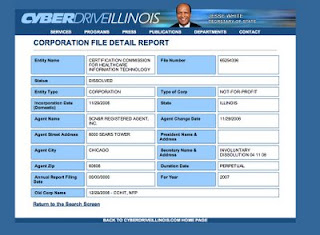
At "A very troubling post about the CCHIT" I reported on a finding that the Certification Commission for Healthcare Information Technology's corporate status was "involuntarily dissolved 0n 4/11/08." Its current state appears as "dissolved" in the database of corporations/LLS's maintained by the Illinois state government, CyberDriveIllinois at http://www.ilsos.gov/corporatellc/CorporateLlcController.

I called the CyberDriveIllinois support number today (would have done so yesterday, but it was a holiday) listed on the Secretary of State Business Services Contact Form as "For certified copies and copy requests for corporations, please call (217) 782-6875."

Two different staffers told me the database is accurate and up to date, and confirmed that file 65254336, Certification Commission for Healthcare Information Technology, old name CCHIT, had a current status of "dissolved."

Therefore, might one not reasonably conclude the CCHIT, with administrative offices at 200 S. Wacker Drive, Suite 3100, Chicago, Illinois per its marketing director, is operating (in some manner) without being registered in the state in which it is conducting those operations?

I ordered a copy of the file on the dissolution and will report on what it contains.

Yesterday morning I also sent the following email to Sue Reber, Marketing Director, the contact person listed on a response posted to the WSJ blog and as a comment to "A very troubling post about CCHIT" here at Healthcare Renewal.

Ms. Reber had written that "CCHIT was founded originally as a LLC but has subsequently transitioned to a private, nonprofit 501(c)3 organization. That is its current status."

I asked:

To: sreber@cchit.org
Date: 02/16/2009 07:55AM
Subject: Question: Involuntary dissolution of 4/11/08

Dear Ms. Reber,

I am am medical informaticist and blogger at multiauthor blog "Healthcare Renewal."

With regard to your posted response to the WSJ health blog comment here about CHHIT, am still curious as to the involuntary dissolution of 4/11/08 -- what was that about? - and the absence of an "active" entry in the Illinois' online corporation/LLC search utility.

I have not received a response, but did receive this automated return receipt from my emailer:

Your message
To: Sue Reber
Subject: Question: Involuntary dissolution of 4/11/08
Sent: Mon, 16 Feb 2009 06:55:43 -0600
was read on Mon, 16 Feb 2009 10:43:20 -0600

I await a reply.

-- SS


Addendum:

At the original WSJ blog comments site where the first Feb. 13 comment from "CJ" and the response from Mr. Reber appeared, there is a new Feb. 17 comment by "Calvin Jablonski" (link).

The new comment makes, among others, claims that
Mark Leavitt was employed by HIMSS for some period of time, that CCHIT jury observed testing is not independent 3rd party testing and validation because of who performs it, that there are numerous conflicts of interest with HIMSS and other organizations, that taxes have not been paid, and that CCHIT is a shell of some type.

I do not know if these are true and do not vouch for their accuracy.

However, the comment concludes with "the public has a right to know the truth from outside independent sources."

I tend to agree, considering that bad informatics can kill.

-- SS

Friday, February 13, 2009

A very troubling post about the CCHIT (Certification Commission for Healthcare Information Technology)

  • Also see my second Feb. 17 post here, and my third post on Feb. 19 here where I commented on HisTalk's take on these issues.

Feb. 13:

I have observed unseemly things about health IT in my nearly two decades in medical informatics. For example, my dealings with health IT vendor HBOC (no relation to HBO and now merged into McKesson) whose erstwhile CEO was cooking the books, and a-little-too-cozy relationships between hospital CIO's and health IT vendor CEO's.

Even considering those observations, the matter below is quite unsettling if its allegations are valid. It is additionally unsettling considering the many well-intentioned volunteers who give of their time in CCHIT activities, whose reputations might be unfairly tarnished if there are significant undisclosed problems. (I applied to be a volunteer some years ago, in fact, but was not selected initially, and did not reapply due to my work schedule).

Seen at the WSJ Health Blog here about the CCHIT (Certification Commission for Healthcare Information Technology) is the post below. An involuntarily dissolved organization? Conflicts of interest with HIMSS, the Healthcare Information and Management Systems Society (a healthcare IT vendor alliance), and other "front" organizations?

I do not know who posted this series of allegations, and importantly do not represent them as true; they may be rumors, misinformation, politically motivated or statements of disgruntled individual(s). However, I checked one of the allegations and verified it. I utilized Illinois' online corporation/LLC search utility at http://www.ilsos.gov/corporatellc/CorporateLlcController and did indeed find this puzzling entry for CCHIT as "involuntarily dissolved" on 4/11/2008. I could not find other entries even under the full name "Certification Commission for Healthcare Information Technology."

Here is the results screen (click to enlarge):


Edgar online company search finds no company listings for "CCHIT" or "Certification Commission for Healthcare Information Technology", either.

Another private nonprofit lookup of unknown reliability, Melissadata.com, shows CCHIT as a 501 (c)(3) in Chicago listed as "exempt" from taxes since October 2008, last 990 form ("Return of Organization Exempt from Income Tax") filed Dec. 2007, form 990 amount $4,740,146, as shown here. This would have been before the involuntary dissolution. No 2008 form 990 data is shown.

A number of reasons for involuntary dissolution of a nonprofit in one state can be seen here.

This certainly raise concerns and questions such as:

  • Why was this not for profit "involuntarily dissolved" in April 2008? For what reason(s)?
  • By whom?
  • What replaced it?
  • Why was this dissolution not widely known?
  • What is CCHIT now? Is the Illinois online corporation/LLC database faulty? Does it remain a non-profit?
  • If the Illinois database is not faulty, where is CCHIT now registered? Is it registered?
  • Is it a subsidiary of HIMSS or other organization?
  • Where do CCHIT monies go?
  • Who controls the funds?
  • Who assures that it is indeed impartial in its assessments?

The posted comment at the WSJ health blog that caught my attention reads (emphases mine):

Why not pack CCHIT EHR certifications in Cracker Jack Boxes? If folks think CCHIT is a real organization and the certification is anything more then a stamp of approval from the HIMSS Circus they need to think again after looking at the facts.

Some facts are known about the Certification Commission for Health Information Technology. The Certification Commission for Health Information Technology (CCHIT) is a defunct Illinois Not-For-Profit 501(c) 3, which operates to take money from the Office of the National Coordinator and Vendors by offering to sell a “Certification”.

DID I say DEFUNCT? Yes I said DEFUNCT…please read on.

The Not-For-Profit 501(c) 3, Certification Commission for Health Information Technology (CCHIT), operates a “Front” office located at 200 S. Wacker Drive, Chicago, Illinois.

CCHIT, as it is known, represents itself as a government recognized organization for certifying electronic health records. CCHIT has received monies from the United States Government (estimated over $2.5 million to date) and monies from vendors of electronic health records.

CCHIT was formed as a NFP in the State of Illinois and is an entity spawned by none other, HIMSS.org. CCHIT is no longer a legal entity existing within the State of Illinois effective April 11, 2008, but continues to engage business as a 501(c) 3 accepting payments as reported by J. Morrisey, Director of CCHIT Communications (February 3, 2009).

CCHIT continues to hold itself out to take money for the sale of “Certification” (a rubber stamp device the buyer can display on his product if the fee is paid), a contrived performance standards product label developed by its parent organization, Healthcare Information and Management Systems Society (HIMSS), a lobbyist, with headquarters at 230 E. Ohio St., Chicago, Illinois.

CCHIT was also located within the HIMSS Headquarters at 230 E. Ohio Street in Chicago but moved to Wacker Drive apparently due to appearances of being too close to the lobbyist parent organization.

CCHIT, through the organization that spawned them—HIMSS.org, a lobbyist organization—recently asked for $25 Billion additional funds in an open letter to the Obama administration (http://www.himss.org/advocacy/). HIMSS, through its agent H. Stephen Lieber, provided CCHT with $300,000 seed money in 2006 with which to fund a startup operation.

HIMSS receives money from CCHIT as a subcontractor, as the payoff for seeding the startup. HIMSS provides public commentary through the use of its own members for certification criteria back to CCHIT. HIMSS is also the parent company for the Electronics Health Record Vendor Association (EHRVA), another Not-For-Profit housed at 230 E. Ohio St., Chicago, Illinois.

The Facts:

1. The Chairman of CCHIT is Mark Leavitt, MD, PhD. Mark Leavitt is also Chief Medical Officer with HIMSS.org. It is believed Mark Leavitt may be a relative of Mike Leavitt, former HHS Secretary [doubtful - ed.]

2. CCHIT takes federal money, and money from vendors, in exchange for the sale of “certification”. CCHIT does not have a legitimate physical address where it conducts its testing. CCHIT has a “front” office at 200 S. Wacker Drive, Chicago, Illinois, with previous headquarters at 230 E. Ohio St., Chicago, Illinois. CCHIT is, in fact, now defunct.

3. CCHIT has no legitimate registration certificate of good standing with the State of Illinois, the state in which it is purportedly chartered as a 501(c) 3. It is, in fact, listed as “involuntarily dissolved” effective April 11, 2008, file# 65254336. Illinois State listing here: http://www.ilsos.gov/corporatellc/

4. CCHIT does not provide independent inspections of its facility or 3rd party reviews of its findings. “Certification” status of vendor products granted by CCHIT after the Illinois State’s involuntary dissolution date of April 11, 2008 appears to be without merit or bogus, and CCHIT operates deceptively to convey legitimacy.

5. CCHIT operates fraudulently within the State of Illinois and in the United States to take money from vendors of electronic health record systems and from taxpayers; the CCHIT business practice presents as a Pay-For-Play scheme; if the vendor pays, CCHIT certifies the product conveying a competitive advantage in the marketplace. There is no transparent certification testing for 3rd party review. The costs to certify are in the many tens of thousands per vendor. Officers and Directors of CCHIT have taken money in exchange for “Certification“, knowing its 501(c) 3 operational status to be defunct.

6. CCHIT, a dissolved entity and defunct 501(c) 3 Not-For-Profit, receives funding from the Office of the National Coordinator (ONCHIT) and is tied to a lobbyist organization that claims to be a Not-For-Profit, HIMSS.org—the organization that spawned CCHIT and which formerly housed the entity in its corporate headquarters located at 230 E. Ohio St., Chicago, Illinois. Why does CCHIT continue to certify vendor products when its own corporation has been involuntarily dissolved? Does the word “MONEY” ring a bell?

CCHIT continues to hold itself out as a certifying entity when it can’t even certify to the state of its incorporation that it does in fact exist.

Closing thoughts:

The certification process and testing should be reviewed carefully, and those vendor companies whose products were certified after CCHIT’s involuntary dissolution should be contacted. Money should be returned to the vendors and the taxpayers- CCHIT is a bogus operation.

CCHIT should NOT be allowed to receive future Federal grants and monies from the United States Government as part of the stimulus package. CCHIT is defunct, moreover the cozy relationships between CCHIT, ONC, CMS, HITSP and others are bankrolled with taxpayer money and money from HIMSS.org and its others.

Through all the smoke and mirrors we the people are supposed to trust these [derogatory term redacted - ed.] and they actually think we are buying it?

There is no point in CCHIT holding itself out as a legitimate entity at HIMSS Annual Conference either, CCHIT is a defunct organization and has been since the beginning of 2008…DUH!

CCHIT has flown under the radar for a year and a half, the jig is up and the whistle has been blown.

CJ

Comment by cj - February 13, 2009 at 2:10 am

I find these allegations potentially very troubling regarding an organization that is supposed to be "impartial" and a judge of the suitability of electronic health records products for sale here in the U.S. The answers may be simple and straightforward. I hope they are. Healthcare IT already has significant problems and needs no more.

These are important issues worthy of clarification. I would welcome clarifications from CCHIT, which I will certainly publish here.

-- SS

Addendum

Feb. 15:

I note the following response at the WSJ blog:

The “facts” in the previous post are deliberate misinformation from an anonymous source.
1. Mark Leavitt, chair of the Commission, is not employed by HIMSS as CMO nor is he a relative of Mike Leavitt, previous Sec. of HHS.
2. CCHIT conducts jury-observed and technical testing of vendor-submitted products, requiring that the products meet 100% of the compliance criteria published at http://www.cchit.org/certify/index.asp. It’s current administrative offices are at 200 S. Wacker Drive, Suite 3100, Chicago, Illinois.
3. CCHIT was founded originally as a LLC but has subsequently transitioned to a private, nonprofit 501(c)3 organization. That is its current status.
4. CCHIT operates with the oversight of both its board of trustees - managing its business functions - and board of commissioners, which provides oversight of its certification development programs and inspection processes.
5. CCHIT’s trustees and commissioners receive no compensation; they serve in a volunteer capacity. CCHIT operates with a paid staff of about 20 personnel who support the work of the Commission and it’s 15 volunteer work groups, administer the certification inpections and provide outreach to its diverse stakeholders
6. CCHIT now operates independently of HIMSS, AHIMA and NAHIT - its founding organizations - and no money provided by ONC for developent or by vendors for the conduction of inspections is returned to those organizations.
Any questions about CCHIT’s operations may be directed to me at the following email address.
Sue Reber, Marketing Director
CCHIT
sreber@cchit.org

This still does not explain the involuntary dissolution nor the absence of an "active" entry in the Illinois' online corporation/LLC search utility. I have sent Ms. Reber an initial inquiry.

It also does not explain possible conflict of interest concerns. If CCHIT operates independently of HIMSS, AHIMA, and NAHIT, why are individuals from some of these organizations acting as Trustees? Why are vendor officials acting as Commissioners?

Organizations such as the ECRI Institute, that independently evaluates medical technologies, seems to have a credible approach to avoid appearances of conflict:

The Integrity of Independence

Our conflict-of-interest rules have been carefully developed to create an environment that maximizes objectivity, productivity, and integrity of process. We accept no advertising revenues from any source. Our employees are not permitted to own stock shares in medical device or pharmaceutical firms, and we verify this by examining each employee’s federal income tax return. We go beyond the industry norm to ensure that you receive unbiased guidance.
-- SS

(also see my Feb. 17 follow up post here.)