Showing posts with label Mismanagement. Show all posts

Friday, March 24, 2017

An eloquently expressed lesson from Nanaimo (Canada) on electronic medical records failure

Unfortunately, this eloquent piece on EHR failure expresses precisely the major problems with this experimental technology that generic medical managers and other medical bureaucrats are unwilling to hear, and/or unable to fully comprehend.

At my May 31, 2016 post "HIT Mayhem, Canadian Style: Nanaimo (Vancouver Island) doctors say electronic health record system unsafe, should be shut down, non-medical PR hacks say it's perfectly safe" at http://hcrenewal.blogspot.com/2016/05/hit-mayhem-canadian-style-nanaimo.html, I wrote:

... To hell with doctors and nurses and their concerns about horrible health IT.   

That seems the international standard in 2016 regarding their concerns.  There's just too much money to be made in this business to worry about such piddling annoyances as maimed and dead patients.

Doctors, after all, don't know anything about computers, and cybernetic medical experiments on unconsenting human subjects are
 just good fun.

This new example from Canada:


http://www.theprovince.com/health/local-health/nanaimo+doctors+electronic+health+record+system/11947563/story.html 

Nanaimo doctors say electronic health record system unsafe, should be shut down

By Cindy E. Harnett
Victoria Times Colonist
 
May 27, 2016

Implementation of a $174-million Vancouver Island-wide electronic health record system in Nanaimo Regional General Hospital — set to expand to Victoria by late 2017 — is a huge failure, say senior physicians.

Who cares what they say?  They're just doctors, so sayeth the imperial hospital executives.. 


Here is an update:

http://www.canadianhealthcarenetwork.ca/physicians/discussions/opinion/a-lesson-from-nanaimo-on-the-human-costs-of-electronic-health-records


A lesson from Nanaimo on the human costs of electronic health records

WRITTEN BY DR. DAVID FORREST ON MARCH 22, 2017 FOR CANADIANHEALTHCARENETWORK.CA

Dr. David Forrest (Dr. Forrest is a Nanaimo internist and the president of the Nanaimo Medical Staff Association.)

For the last 12 months, staff at Nanaimo Regional General Hospital in B.C. have been using a Cerner-based electronic health record (EHR). This includes computer physician order entry, linked to computerized order management, and fully electronic documentation.

Since shortly after the system was activated, physicians have consistently and increasingly expressed concerns about the safety of the system (with, for example, orders being mistranslated by the system or disappearing) and its inefficiency, which reduces patient access to care. As a consequence, with the support of the B.C. Ministry of Health, the Island Health Board has directed the Health Authority to suspend CPOE and related processes—though Island Health is delaying this.

While the primary issues with iHealth have focused on safety concerns, little attention has been paid to the human costs of the EHR and its implementation.

"Little attention has been paid to the human costs" due to the fact that most of that attention has gone to the entity that seems to have usurped the rights of patients and clinicians, namely, computers.   "Cybnernetics over all" seems the continuing saga of healthcare, as I'd written in the past.

I am increasingly appalled when I read common accounts like this, now ongoing since my entry into medical informatics 25 years ago.  The term "learning organization" that I've been hearing since the 1990's extolled as what healthcare managers claim they aspire to seems a sad joke.


Currently designed EHRs significantly alter processes of care. Computerised order entry is a laborious process, requiring multiple steps to perform simple tasks. As demonstrated in other settings (such as the airline industry), such complex processes are inherently error-prone. Moreover, the inputting of more intricate orders is even more difficult, resulting in “work-arounds” or inaccurate enactment of physician management plans, with additional safety risks.


I've written in past posts that the "atomization" of order entry and other functions into multiple subcomponents with different user interface widgets, rules and "gotcha's" is a monstrous tool created by those without a knowledge of what it's like in chaotic patient care environments.  Those designers also seem, for example, to lack the ability to design tools that parse freetext orders into those atomic parts with little user intervention.  The syntax of the bulk of medical ordering is not all that complicated, for example.

“User error” has become a buzz phrase for system-based processes that result in inability to enact orders as intended by physicians—and physician users are the ones responsible, thus morally if not legally liable not just for order entry but for their management downstream. It is little wonder physicians in Nanaimo since the introduction of the EHR feel uncertain, anxious, frustrated and exhausted.

Two points, the first of which I expressed to the author via email. 

First, "user error" is a buzz phrase for those ignorant of human-computer interaction best practices to lay blame for faulty designs on victimized (and usually compelled) users.

The more correct term in many cases is "use error" - not "user error."  Use error, as defined by the US National Institute of Standards and Technology (NIST) in their study of health IT, is as follows (see also my Oct. 2011 post at http://hcrenewal.blogspot.com/2011/10/nist-on-ehr-mission-hostile-user.html):

“Use error” is a term used very specifically to refer to user interface designs that will engender users to make errors of commission or omission. It is true that users do make errors, but many errors are due not to user error per se but due to designs that are flawed, e.g., poorly written messaging [or lack of messaging, e.g., no warnings of potentially dangerous actions - ed.], misuse of color-coding conventions, omission of information, etc.


The second point I will make regarding clinicians feeling "uncertain, anxious, frustrated and exhausted" is that this health IT fits the definition of bad health IT in terms of its creating stressors:


Bad health IT is ill-suited to purpose, hard to use, unreliable, loses data or provides incorrect data, is difficult and/or prohibitively expensive to customize to the needs of different medical specialists and subspecialists, causes cognitive overload, slows rather than facilitates users, lacks appropriate alerts, creates the need for hypervigilance (i.e., towards avoiding IT-related mishaps) that increases stress, is lacking in security, lacks evidentiary soundness, compromises patient privacy or otherwise demonstrates suboptimal design and/or implementation. 


That definition was the result of joint thinking by myself and a colleague, Australian informaticist Jon Patrick, PhD.

This experience is not singular, as a number of studies in the U.S. suggest that EHRs are now the primary cause of physician burnout. This further jeopardises patient care since the presence of an EHR has become a barrier to recruitment and retention of healthcare workers—and not just of physicians.


If this is true, and I believe it largely is, any claimed benefits of EHR technology must be seriously questioned as to the benefit/cost (downsides) ratio.  This is also NOT what the pioneers who taught me during my Medical Informatics fellowship a quarter-century ago intended, and this deviation from their intentions can be accounted for only by numerous social pathologies I will not get to in more depth in this post.

The following is quite eloquent, expressing the problems in a way I rarely recall seeing so lucidly stated:

Documentation changes have also affected patient care. A patient’s journey through illness and during their stay in hospital is a story or narrative—hence our documentation of that narrative as a history. Our understanding of it in this manner is critical not only to diagnosis and management, but to contextualizing it for the individual patient.

“Progress notes” in the EHR no longer describe progression of disease, but document it rather as an episodic and disjointed accounting of the patient’s condition. And the nursing narrative has been eliminated in favour of checklists of patient experience as data points. As a result, we have lost our holistic knowledge of the patient and his/her illness and are unable to transmit this understanding clearly from one provider to another.  This is detrimental to providing high-quality patient care.

Understanding the crucial differences between narrative of a patient's journey and an episodic, disjointed "data dump" as EHRs now foster is perhaps a capability that differentiates those who were able to get the grades necessary for entry into medical school and succeed there through school, internship, residency and perhaps specialty fellowships, from those with lesser abilities to think abstractly and outside narrow mental confines of datapoints as descriptors of the messy real world.


Focus on the collection and inputting of clinical data or struggling with order entry and documentation further dehumanizes patient care. The interaction of healthcare providers and patients is perhaps the most intimate of relationships outside personal or familial ones. This therapeutic relationship is crucial to providing care, whether for cure or for comfort.


To those whose most intimate relationships are with metal boxes with flashing lights, this issue may also be hard to comprehend fully.


An episode of patient care is now primarily defined by interaction with the computer, which detracts from the provision of care. This experience has been corroborated in a recent study from Calgary, documenting that healthcare workers operating in an EHR environment spend up to 90% of their time during clinical work on the computer rather than with the patient.


I have seen this myself while visiting friends in hospital - banks of nurses lined up against a wall of computer workstations, typing away for the bulk of my visits.    It is - I'm sorry to use this term - nuts, and those who are behind such a system of medical work, managerially speaking, lack both competence and common sense.


... Reliance on order sets developed by experienced practitioners is potentially detrimental for trainees, who do not then have the opportunity to learn the clinical thinking processes that underpin them. Given the reliance on order sets to address inefficiency and safety concerns inherent to the ordering processes in an EHR, physicians at the most crucial stages of learning are not able to develop these critical thinking processes that form the basis for the practice of medicine.


The term of art for this is "deskilling."  I am highly concerned about the quality of young physicians training in cybernetic hospitals, who become automatons without the skills to act appropriately when "off-script" (a rather common occurrence in medicine).


Moreover, given the inefficiency of EHR processes, there is reduced time available for clinical teaching. This has been a universal experience (and complaint) of trainees in Nanaimo. In other jurisdictions, trainees have become effective scribes to unburden staff physicians—an activity I do not believe contributes to the educational experience. Additionally, trainees focus on learning to navigate and use the EHR, rather than attending to patient care or clinical education. We are at risk of producing a generation of physicians with poor clinical skills and who are disconnected from patients.


Medicine is becoming outright enslaved to its cybernetic masters.


The loss of bond with patients is mirrored by disconnection within the healthcare team. EHR processes serve to isolate rather than enhance personal interactions between physicians and nurses, pharmacists and allied health professionals. Healthcare requires collaboration and coordination between many types of providers, a process that is not just crucial to optimal patient care but necessary to support and enhance the performance of individual team members. Disruption of the team approach impairs patient care and has demoralized the healthcare community in Nanaimo.


The social bonds and interactions that hold the complex endeavor of medical care together, in reality, have been usurped by (as I've written before) a grand human subject experiment, without consent of the experimental subjects, namely, clinicians and patients.  Both utopian idiocy and old fashioned opportunism are at work (see "Background On The 'Ecosystem' of Commercial Healthcare IT" at http://cci.drexel.edu/faculty/ssilverstein/cases/?loc=cases&sloc=ecosystem).


This has been made worse by the adversarial relationship created when a majority of medical staff who have found continued use of the computerized order management processes unacceptable are opposed by physicians, some allied health professionals and administrators who do not. Some of our most experienced physicians and allied health professionals have retired or changed practice. To say the effects on the health care community in Nanaimo have been destructive is not an understatement. This also means that collaborative work on care needs for our community beyond iHealth has largely stalled.


I believe that the physicians who truly like today's EHRs are in the minority.  As to administrators, if they are not clinicians, they have no business overruling their clinicians on such matters.

What is being eloquently described in this essay is a mass failure of bad health IT that is disrupting medical documentation, medical care (likely resulting in numerous bad outcomes), medical communications, medical education, medical morale, medical esprit de corps, medical recruting and retention, and the health of the community - among others.

Other than those minor drawbacks, everything is fine.

-- SS


Monday, January 09, 2017

Heath IT Mismanagement: MD Anderson to cut about 1,000 jobs due to "financial downfall officials largely attributed to its EPIC EHR implementation project"

At numerous posts on this blog I link to stories of health IT expense putting hospital financial stability at risk, e.g.:

"What is more important in healthcare, computers, or nurses and other human beings? Southcoast Health cutting dozens of jobs on heels of expensive IT upgrade" at http://hcrenewal.blogspot.com/2016/04/what-is-more-important-in-healthcare.html

"Lahey Health: hospital jobs lost, but computer vendors prosper" at http://hcrenewal.blogspot.com/2015/05/lahey-health-hospital-jobs-lost-but.html,

"Monetary losses and layoffs from EHR expenses and EHR mismanagement" (http://hcrenewal.blogspot.com/2013/06/monetary-losses-and-layoffs-from-ehr.html),

"Financial woes at Maine Medical Center: Reading this blog might have saved them millions of dollars, and prevented massive 'cost saving initiatives'" (http://hcrenewal.blogspot.com/2013/05/financial-woes-at-maine-medical-center.html),

and "In Fixing Those 9,553 EHR "Issues", Southern Arizona’s Largest Health Network is $28.5 Million In The Red" (http://hcrenewal.blogspot.com/2014/06/in-fixing-those-9553-ehr-issues.html)

Here's another recent example:

MD Anderson to cut about 1,000 jobs 
Becker's Hospital Review 
Ayla Ellison
Jan. 5, 2017
http://www.beckershospitalreview.com/hospital-management-administration/md-anderson-to-cut-1-000-jobs.html

The University of Texas MD Anderson Cancer Center in Houston plans to eliminate about 1,000 jobs, or 5 percent of its 20,000-person workforce, as it tries to improve its financial health.

At a press conference Thursday, MD Anderson officials said between 800 and 900 workers will be laid off, and an additional 100 to 200 jobs will be cut through retirement and attrition, according to the Houston Business Journal. The job cuts will not affect any physicians.

"We primarily focused on those areas where we could make staff reductions, re-engineer administrative support, and not impact quality of patient care," officials said at the press conference, according to the report.

The job cuts are expected to save MD Anderson about $120 million a year.

MD Anderson is scaling back its workforce after it reported a combined $102 million operating loss in September and October and a $9 million operating loss in November. At the press conference Thursday, MD Anderson CFO Dan Fontaine said the organization likely does not have a positive operating margin for December, according to the report.

MD Anderson's financial troubles began in early 2016 when it rolled out a new Epic EHR system. The organization recorded a 76.9 percent drop in adjusted income for the 10 months that ended June 30, 2016, a downfall officials largely attributed to its EHR implementation project.

It appears MD Anderson failed to estimate health IT costs and impacts properly, and/or failed to write safeguards for seller-caused cost overruns into its contracts. 

That is known as "mismanagement" by definition.  

It's not as if information important to such planning was unavailable.  In fact some of it is free at this very blog, e.g., the 30 or so posts under the query link http://hcrenewal.blogspot.com/search/label/EPIC.

Despite its sagging financials, MD Anderson officials said Thursday the organization's long-term financial health remains strong.

"We are innovating to develop novel care delivery models, adopting enabling technologies and diversifying revenue streams," said MD Anderson in an emailed statement. "MD Anderson will be here for patients and their families today, tomorrow and long into the future."


Not if those efforts are mismanaged as badly as this one.

Finally, perhaps the cost of commercial EHR software needs to be critically investigated. 

That it could put an organization of the stature of an MD Anderson in jeopardy seems to me to be a red flag, mismanagement or not.


-- SS

Note:  I have not posted in awhile due to being occupied with EHR forensic and evidentiary issues.  

Wednesday, July 13, 2016

Two recent stories of EHR un-exceptionalism, and a connection to prior HC Renewal posts including my own experiences

The following stories recently appeared in the press about the "un-exceptionalism" (or, I might more accurately state, the negative exceptionalism) of today's EHR technology.

Regarding each organization mentioned, I have had personal experience that, in retrospect, aligns with views I expressed about the organizations years ago.

First:

EHR safety goes to court
By Lisa Schencker
June 25, 2016
http://www.modernhealthcare.com/article/20160625/MAGAZINE/306259982

One patient's blood pressure plummeted dangerously after he was allegedly discharged with the wrong medications. In another instance, a physician couldn't place a pharmacy order for a newborn to receive vitamin K, which is given to babies to prevent serious bleeding.

On several other occasions, patients weren't accurately tracked, creating potential problems getting drugs to them.

Each of these alleged mishaps occurred at PinnacleHealth, a three-hospital system based in Harrisburg, Pa. PinnacleHealth blames each of the mishaps on its electronic health records vendor, Siemens; Cerner Corp. purchased Siemens' health IT business in February 2015.

The relationship between healthcare system and vendor devolved into this dueling lawsuit:

The incidents came to light as part of a breach-of-contract lawsuit Cerner filed against PinnacleHealth last year after the system, which had used Siemens as a vendor for 20 years, sharply curtailed its relationship and entered into a contract with a competing EHR vendor, Epic Systems Corp. PinnacleHealth related the incidents in its counterclaim; the counterclaim was filed in March of this year in state court in Pennsylvania, where it is seeking damages for Cerner's alleged fraud and breach of contract.

(I am cited in the article with respect to hold harmless clause-related issues not relevant to this blog posting.)

Cerner Corp. purchased Siemens' HIT business in Feb. 2015.  Prior to that, Siemens was an independent vendor of an EHR suite known as Soarian, deployed at PinnacleHealth as early as 2008.

See for instance http://news.usa.siemens.biz/press-release/customer-solutions/soarian-plan-care-assists-clinicians-developing-and-deploying-goal-

Soarian Plan of Care Assists Clinicians in Developing and Deploying Goal-Oriented Plans of Care
Monday, February 25, 2008

Siemens (http://www.usa.siemens.com/healthcareit) today announced that PinnacleHealth, a 750-bed, non-profit hospital and healthcare system serving Central Pennsylvania, and CentraState Healthcare System, a 272-bed, non-profit medical facility located in Freehold, N.J., have each signed on to serve as beta sites for Soarian® Plan of Care, a solution designed to support inter-disciplinary care teams in defining and helping to manage patient problems, interventions and expected outcomes, to provide care in order to achieve desired outcomes and to generate new knowledge at the point of care.

Notwithstanding my warnings on this blog and elsewhere that hospitals should NEVER be "beta testing sites" for experimental HIT software used on live patients without informed consent, that the relationship devolved to dueling lawsuits involving safety is not a surprise to me.

Relating to my own experiences as posted previously on this blog:

On August 20, 2009 I posted "Why Siemens Healthcare Fails" (http://hcrenewal.blogspot.com/2009/08/why-siemens-healthcare-fails.html).  In that post I noted regarding a job posting by Siemens for a "physician consultant" on HIT implementation:

... This [Siemens] job description might better be described as "glorified salesperson." It might be a good exit route for a "techie doc" (usually, someone who knows just enough about HIT to be destructive) who hates the current practice environment. It might also be good for managers who don't want knowledgeable experts pointing out their bad decisions and mismanagement, but I think a global company like Siemens should be setting its sights higher in such a crucial area as electronic medical records and clinical IT consultants.

I would not want such a physician advising or supporting complex HIT projects at my organization.

I also recalled my own Siemens face time:

... I spent time at Siemens Healthcare headquarters in Erlangen in 2000, and was offered gracious hospitality and a position overseeing the Soarian cardiology suite [as a result of my work in development of an extensive cardiology information system as CMIO at Christiana Care in Delaware from 1996-8]. The people I met in Erlangen then seemed extremely competent and informatics-savvy, but I turned the offer down through no fault of Siemens. I'd received a near-simultaneous offer (FAXed to my hotel in Erlangen, in fact) from pharma that involved a much stronger management role.

I understand through conversations over the past few years with current and ex-Siemens personnel that most of the Siemens personnel I'd met in Germany in 2000 are no longer with the company. I was told they'd performed suboptimally after the acquisition/merger with Shared Medical Systems (SMS) in Malvern, PA. (I do not find that credible, and would find it far easier to accept that the problems were on the American side, but that is a personal opinion.)

I'd informed my German hosts in 2000 that they'd better be very, very careful about acquisition of an American HIT company due to my experiences with a number of such companies, which I found highly political and highly ignorant of EHR quality issues.

Then, in my Feb. 2016 post "Plaintiff's Lawyers Are The Cause of EHR Problems?" (http://hcrenewal.blogspot.com/2016/02/himss-2016-presentation-plaintiffs.html) I recounted further experience with Siemens:

... an anecdote regarding the health IT Industry in the U.S.: the cardiology information system I developed, linked to above in the 2nd bullet point, was seen in 2000 by German engineers at Siemens Healthcare Erlangen as exemplary, and they offered me a position to further develop it, that I declined due to a simultaneous superior offer from Merck Research Labs.  However, in 2007 when I again spoke to Siemens, this time to Americans at the former Shared Medical Systems in Malvern, PA that had been acquired by Siemens, they found a system that actually produced clear, detailed outputs in a critical care area and was in use at the time in a major healthcare system in the region "impractical" - and never followed up with me.  Pearls before....)

 Finally, Siemens seems to have ignored a well-qualified informatics internal expert on explicit EHR safety warnings, as in my Feb. 8, 2010 post "A Lawsuit Over Healthcare IT Whistleblowing and Wrongful Discharge: Malin v. Siemens Healthcare" (http://hcrenewal.blogspot.com/2010/02/lawsuit-over-health-it-whistleblowing.html):

  • Siemens Medical's physician internal consultants (skilled anesthesiologists/informatics specialists), apparently in writing and including a remediation plan, opined that an IT system developed for critical care had numerous severe flaws, of sufficient seriousness that in their opinion the systems could harm or even kill patients if deployed;
  • These were warnings of defects and flaws in IT in the worst possible medical environment, critical care with the sickest and most vulnerable of patients, not some ambulatory clinic or primary care office;
  • Allegations were raised that the warnings were ignored, with at least one of the physicians, Dr. Malin, who was strongly concerned and vocal about the risks then being told his position was being eliminated. [It is not a surprise to note this rings alarm bells about the possibility of wrongful discharge based on retaliation and/or "greasing the skids" to eliminate potential whistleblowers or "non-team players" who could delay release of the software and affect revenue - ed.];
  • The company possibly ignored the remediation plans of their own clinician/informatics experts;
  • There were allegations of company misrepresentations about the new system to the FDA;
  • There were allegations of decision making on these issues by non-clinician IT managers lacking healthcare or healthcare informatics expertise.
  • A wrongful discharge complaint and then lawsuit were filed by Dr. Malin on the basis of violation of the whistleblower protection provisions of the Sarbanes-Oxley Act of 2002 (SOX), 18 U.S.C. § 1514A ("Civil action to protect against retaliation in fraud cases - Whistleblower Protection for Employees of Publicly Traded Companies");
  • The suit was dismissed on the apparent technicality that Siemens Medical in the U.S. is not subject to the provision in the SOX Act as is the publicly-traded corporate parent, Siemens AG; from document #4, pg 15:
... Health Services is a wholly-owned subsidiary of Siemens Med ... Siemens Med is a wholly-owned subsidiary of Siemens Corporation, which is indirectly owned, through two intervening layers, by Siemens AG, a German company that is publicly traded as defined by § 1514A of SOX ... Of these entities, only Siemens AG is a publicly-traded company. While both Health Services and Siemens Med are incorporated in Delaware and located in Malvern, Pennsylvania, they are separately incorporated entities.
  • Siemens Medical in their response to the suit denied the most severe allegations regarding the IT defects, but this issue was not followed up upon due to the lawsuit's dismissal on SOX issues despite the obvious potential public hazards the allegations of IT defects could represent;
  • In fact a US District Judge in the case, Peter J. Messitte, in the period after allowing Malin to prove the validity of SOX towards his case, opined that "No other discovery will be permitted, including but not limited to the alleged safety problems of Defendants’ product", document 4 above, Judge Messitte opinion, US District Court Maryland, pg. 25. [While perhaps understandable from a legal perspective, injured or dead patients don't really care about what legal precedents got them into the injured or dead state - ed.]
  • Siemens Medical admitted in their responses to the suit that some of the software in question, actually put in use in hospitals, was in fact "beta" software, i.e., experimental (per Item 38 in 'Siemens Answer to Complaint' document).

There's that "beta-software" issue again.

So, the acquirer (Cerner) of a product of an American Siemens HIT subsidiary that appeared to have what I consider defective HIT talent management practices (as exemplified by the aforementioned JD); bizarre views about successful, high-quality EHR software (seen by their German counterparts a few years prior as exceptional); and that appears to have not been very happy about its own employee warning explicitly of beta ICU software being so bad it could kill patients is now embroiled in litigation regarding safety by a former customer.

None of this is surprising to me at all.  Incompetence can only go so far in healthcare before things blow up.

An unanswered question, of course, is whether patients were harmed or killed as a result of Siemens software, including its beta tests on unsuspecting patients.

---------------------------------

Here is a second story of EHR un-exceptionalism with a personal twist, this article in the Journal of the American Medical Informatics Association (JAMIA):
Comparison of accuracy of physical examination findings in initial progress notes between paper charts and a newly implemented electronic health record, June 28, 2016
http://jamia.oxfordjournals.org/content/early/2016/06/28/jamia.ocw067

Introduction There have been several concerns about the quality of documentation in electronic health records (EHRs) when compared to paper charts. This study compares the accuracy of physical examination findings documentation between the two in initial progress notes.

Methodology Initial progress notes from patients with 5 specific diagnoses with invariable physical findings admitted to Beaumont Hospital, Royal Oak [Michigan, near Detroit -ed.], between August 2011 and July 2013 were randomly selected for this study. A total of 500 progress notes were retrospectively reviewed. The paper chart arm consisted of progress notes completed prior to the transition to an EHR on July 1, 2012. The remaining charts were placed in the EHR arm. The primary endpoints were accuracy, inaccuracy, and omission of information. Secondary endpoints were time of initiation of progress note, word count, number of systems documented, and accuracy based on level of training.

Results The rate of inaccurate documentation was significantly higher in the EHRs compared to the paper charts (24.4% vs 4.4%). However, expected physical examination findings were more likely to be omitted in the paper notes compared to EHRs (41.2% vs 17.6%). Resident physicians had a smaller number of inaccuracies (5.3% vs 17.3%) and omissions (16.8% vs 33.9%) compared to attending physicians.

Conclusions During the initial phase of implementation of an EHR, inaccuracies were more common in progress notes in the EHR compared to the paper charts. Residents had a lower rate of inaccuracies and omissions compared to attending physicians. Further research is needed to identify training methods and incentives that can reduce inaccuracies in EHRs during initial implementation.

Apparently not covered in the article was the issue of patient harms that might have occurred (and could still occur) due to the "significantly higher rate of inaccurate documentation" in the EHR.   

"Beaumont Hospital" caught my eye, as I had interviewed for the CMIO role there in 2007 or early 2008.  My experiences are memorialized in an anonymized post at my Drexel informatics site which I reproduce in part here (the full essay is at http://cci.drexel.edu/faculty/ssilverstein/cases/?loc=cases&sloc=an_expert_says):
Sure, the experts think you shouldn't ride a bicycle into the eye of a hurricane, but we have our own theory

A medical informaticist who formerly held a “Director of Informatics” role a number of years ago in a very large hospital system, and who left the role due to a toxic management environment and lack of authority commensurate with responsibility, was seeking applied Chief Medical Informatics Officer (CMIO) positions once again.  ... He makes the following observations after completing two full rounds of interviews at a prestigious hospital system similar in size to his erstwhile employer, in a very competitive environment, that recently experienced a decline in its clinical quality stats. The organization feels the quality stats themselves were inaccurate, in part due to lack of good healthcare IT.

From what the informaticist was able to gather, their leadership was displeased. Board members were seasoned executives from a heavy-manufacturing industry that is extremely dependent on information technology and concurrent supply chain data. These executives apparently recommended that the organization move quickly on implementing EHRs.

The organization is thus planning to implement EHRs for thousands of physicians, most of whom are not employed by the hospital but are independent private practitioners, and likely to be skeptical or concerned about time impact and “grading” that could affect their livelihoods.  The hospital leaders also wanted to create integrated systems drawing on EHR data to automate quality reporting to regulatory agencies, as well as to support ongoing, funded clinical drug and device trials.

The informaticist was interviewed by the usual mix of clinician eager adopters, clinician skeptics, knowledgeable executives, skeptical executives who knew little about clinical IT, IT personnel who seemed overconfident given the enormity of the tasks at hand, and those who were clearly frightened by the prospect of being held accountable for a project of this magnitude. In the end, the informaticist did not get the position due to the organizational leaders being adamant the incumbent CMIO needed to also practice medicine.  The informaticist had explained on the first round that he believed a leadership role in a project of such magnitude and challenge called for the highest levels of executive presence and freedom from distraction, thus he did not intend to practice medicine (he had not practiced in his former Director of Informatics role for the same reasons).

He’d thought this issue had been settled after the first round of interviews, leading to the invitation for round two. This line of questioning was revisited, however, in round two in a group interview setting. The group interview was attended by a number of people with whom he’d already discussed this issue via individual meetings in round one. This suggested his time was being wasted and was rather annoying, especially considering that the informaticist had flown cross-country not once but twice to an organization not in consensus about a very basic hiring requirement
... It is not as if the organization had a doctor shortage, or that such a role would have ample free time where the incumbent would be idly sitting at their desk unless this time was absorbed seeing patients in the clinic. 

The stated reason for the organization’s wanting the CMIO to practice medicine was “to have credibility with the doctors.”  The informaticist explained that he’d found this not to be the case, that physicians being put “under the gun” of using EHR’s were generally more concerned that the CMIO had the executive authority to best represent their interests and understood medicine from training and practice at some point, not necessarily concurrently with the CMIO role.  Interestingly, there is no empirical research on this point, so the issue was the informaticist’s experience vs. the hospital’s ‘second-guessing’ a seasoned expert.

Ironically, the informaticist was told during his interviews that a CMIO they'd hired a few years ago had left, in part due to being overextended.  He was also told that some of the clinical IT problems he'd solved as a CMIO in the past Director of Informatics position were problems this organization had not been able to solve during the same time frame.

... Regarding underestimation, this organization appeared to have little idea of the difficulties they were getting into

... The informaticist had observed another indication that this organization ‘didn't know what they didn't know.’  He was informed that the organization had selected their EHR vendor prior to seeking a medical informatics expert. This implies they really did not understand what a medical informatics specialist does and can do, which is far more than being a tactical "EHR implementation assistant." ... The informaticist had been there, and had done that in his past role. He found it unrewarding then and actually had decided not to take the risk again, rejecting the new position, even before the organization decided they wanted an (effectively) part-time CMIO who also saw patients.

It was clear this organization, who the informaticist tried to “take to school” based on hard-earned expertise and extensive references on social issues in health informatics (e.g. on this website), felt they were the experts on what was best regarding CMIO background.   This may have been a dysfunctionality satirist Scott Adams once described like this:

Ignoring the Advice of Experts Without Good Reason
Example: Sure, the experts think you shouldn't ride a bicycle into the eye of a hurricane, but I have my own theory.

As I recall, an informatics physician much younger than I and with less experience was hired.  I do not know his fate.  However, I believe that my expertise at that time in EHR issues, and my no-nonsense stance on EHR safety and excellent management, might have averted or minimized the "inaccuracy" problems.

Therefore, it is also no surprise to me that the organization now relates the EHRs were causing significant charting inaccuracies.  It would also not surprise me if close calls and harm occurred. They apparently rode their bicycle into that hurricane, and doing so will usually produce a less than optimal outcome.

In summary, two recent articles on EHR-related lawsuits and operational problems, in my own personal experience, have potentially relevant "backstories" that may help provide context.  Those backstories relate primarily to what I've called "HIT amateurism" (e.g., faulty expertise evaluation) as well as HIT mismanagement (e.g., ignoring explicit internal warnings of dangers.)  I believe my experiences, and that of other such as Dr. Malin, are symptomatic of widespread health IT industry dysfunction.

I also believe that if this industry is ever to learn from its mistakes, it will only occur in the courtroom.  Being that the defense side is usually fierce, however, I am not sanguine needed learning will occur any time in the near future.

-- SS

Thursday, March 17, 2016

Criminal matter for the Attorney General of NY? Hail the gods of medical computing, and the need for human sacrifice. NYC’s $764M medical records system will lead to ‘patient death’: insiders

I believe the suffering and death of my mother in 2010-2011 due to EHR flaws - including but not limited to lack of essential confirmation dialogs on medication deletion at triage, lack of notification messages informing down-line staff of such action by unqualified personnel (inadequate support of teamwork), and other issues - lends me some moral standing to comment on the following as a horrifying and potentially criminal matter. 


Two back-to-back articles appeared in the New York Post:


NYC’s $764M medical records system will lead to ‘patient death’: insiders
By Michael Gartland
March 15, 2016
http://nypost.com/2016/03/15/nycs-764m-medical-records-system-will-lead-to-patient-death-insiders/

and

Hospital exec [CMIO] quits, compares $764M upgrade to Challenger disaster
By Michael Gartland
March 16, 2016
http://nypost.com/2016/03/16/hospital-exec-quits-compares-764m-upgrade-to-challenger-disaster/ 


It is well-known and indisputable that this technology can and does injure and kill, especially when poorly designed, defective, poorly implemented, or all of the above.  See for instance the ECRI EHR risk Deep Dive study results at http://hcrenewal.blogspot.com/2013/02/peering-underneath-icebergs-water-level.html.

Any official in leadership of health IT who denies this - or sidesteps it - or makes excuses for compromises on health IT safety, especially in view of dire warnings from clinician experts - in 2016 is guilty of conduct of the type below:

http://www.legalmatch.com/law-library/article/criminal-negligence-laws.html
What is Criminal Negligence?

Under some criminal law statutes, criminal negligence is defined as any type of conduct that “grossly deviates” from normal, reasonable standards of an ordinary person.  It generally involves an indifference or disregard for human life or for the safety of people.  Sometimes the definition for criminal negligence also requires a failure to recognize unjustifiable risks associated with the conduct.

Examples of criminally negligent behavior may include knowingly allowing a child to be in very dangerous conditions, or driving in an extremely irresponsible way.  Criminal negligence is less serious than intentional or reckless conduct.  Generally, reckless conduct involves a knowing disregard of risks, while negligence involves an unawareness of the risks.

The two articles reflect a good possibility that the politics of what I'd once termed "cybernetics über alles" has trumped patient safety concerns in NYC.

Here's details from the first article:

A new $764 million medical records system is launching at the municipal hospital system on April 2 — even though insiders warn it isn’t ready and patients will suffer.

The soft launch of the electronic system Epic is scheduled at Elmhurst and Queens hospitals.

“Sooner or later, it will crash,” said one source involved in the project. “There will be patient harm — patient harm and patient death.”

That sounds like insiders warning of far more problems than mere crashes causing patient harm and death, a brave act considering possible retaliation.

I wonder if the users of this EPIC system are having imposed on them the speech and though controls imposed on users at University of Arizona (see my Oct. 3, 2013 post "Words that Work: Singing Only Positive - And Often Unsubstantiated - EHR Praise As 'Advised' At The University Of Arizona Health Network" at http://hcrenewal.blogspot.com/2013/10/words-that-work-singing-only-positive.html).

Sources say Dr. Ramanathan Raju, who runs the municipal network, NYC Health + Hospitals, is under the gun from City Hall to meet the deadline and fears he’ll be fired if he doesn’t.

“Raju has said too many times to count that the Mayor’s Office has told him if April 1st doesn’t happen, then Ram will lose his job,” one source said.

The source added that Raju has threatened to fire top executives if the project doesn’t launch on time.

If this is true, than the "gun" from City Hall is aimed straight at patients, and if patients indeed are mortally affected, the responsible officials might be deemed accessories to murder.

I add that this type of situation represents fundamental and severe mismanagement, as I'd been writing about since the late 1990's at my academic site "Contemporary Issues in Medical Informatics: Good Health IT, Bad Health IT, and Common Examples of Healthcare IT Difficulties" at http://cci.drexel.edu/faculty/ssilverstein/cases/.

The hospital system is already on City Hall’s watch list, having required a $337 million bailout in January to stay afloat. 

Money for EHR's grows on trees.

Note other hospitals where EHR implementations led to financial disaster (e.g., http://hcrenewal.blogspot.com/2014/06/in-fixing-those-9553-ehr-issues.html, http://hcrenewal.blogspot.com/2013/05/clouded-visionary-leadership-wake.html, http://hcrenewal.blogspot.com/2013/06/want-to-help-hospital-go-bankrupt-get.html, http://hcrenewal.blogspot.com/2014/06/100-million-epic-install-dampens.html as examples).

Insiders contend that the only safe way to roll out Epic is to take more time — about three months — to address several key issues.

One is planning for a crash, which some consider almost inevitable because the new setup hasn’t been configured to work with systems at other hospitals or with some of its own internal billing and tracking software.

Existing patient data also has to be transferred from the old system — a process that would normally take six months, but which was shoehorned into less than one.

Going "live" with a half-baked EHR under such circumstances for political reasons, if these facts are true, would be, in my professional opinion, an act worthy of prison time if harm results.

“There are supposed to be all these dry runs,” a source said. “They haven’t been done.”

Again, if true, this reflects expediency at the expense of patient well-being, by rows of political hacks, fools and incompetents calling the shots in an area in which they have no business being involved.

City officials contend Epic remains “on-time and within budget.”

I have a feeling this will be revisited at some time in the future - in court.

A mayoral spokeswoman said there would be a round-the-clock effort to ensure there are no glitches. 

"No glitches?" 

That is a hollow promise that cannot be kept even under the best of circumstances.  Under the hellish circumstances described, such a statement is outright frightening. The Mayor truly has no clue about EHR "glitches", but I offer the many posts at query link http://hcrenewal.blogspot.com/search/label/glitch for his education.

Mr. Mayor, here's an example of EPIC and other EHR implementations under the best of circumstances.  These systems are so immensely complex, trying to be pressure-fit into a vastly complex, varying and changing environment, that to not heed CMIO and other expert warnings is the height of recklessness:


Of course, we are reassured that the crack team assigned the implementation duties will produce stellar results:

“NYC Health + Hospitals and its Epic implementation experts are prepared to implement the new system in Queens facilities beginning April 2, and have assembled a team of about 900 technicians and Epic experts who will work around-the-clock that week both in Queens and at remote data centers to ensure the transition to the new system goes as smoothly as possible,” said spokeswoman Ishanee Parikh.

EPIC experts like these?  From this link at the "Histalk" site on staffing of health IT projects, Aug. 16, 2010. Emphases mine:

Epic Staffing Guide 

A reader sent over a copy of the staffing guide that Epic provides to its customers. I thought it was interesting, first and foremost in that Epic is so specific in its implementation plan that it sends customers an 18-page document on how staff their part of the project. 

Epic emphasizes that many hospitals can staff their projects internally, choosing people who know the organization. However, they emphasize choosing the best and brightest, not those with time to spare. Epic advocates the same approach it takes in its own hiring: don’t worry about relevant experience, choose people with the right traits, qualities, and skills, they say. 

The guide suggests hiring recent college graduates for analyst roles. Ability is more important than experience, it says. That includes reviewing a candidate’s college GPA and standardized test scores. 

I bet many readers were taught by their HR departments to do behavioral interviewing, i.e. “Tell me about a time when you …” Epic says that’s crap, suggesting instead that candidates be given scenarios and asked how they would respond. They also say that interviews are not predictive of work quality since some people just interview well. 

Don’t just hire the agreeable candidate, the guide says, since it may take someone annoying to push a project along or to ask the hard but important questions that all the suck-ups will avoid. 

Epic likes giving candidates tests, particularly those of the logic variety.

The part about "not worrying about relevant experience" and about "hiring recent college graduates as HIT project analysts" is bizarre if true, and downright frightening.

Medical environments and clinical affairs are not playgrounds for novices, no matter how "smart" their grades and test scores show them to be. These practices as described, in my view, represent faulty and dangerous advice on first principles.  The advice also is at odds with the taxonomy of skills published by the Office of the National Coordinator I outlined at the post "ONC Defines a Taxonomy of Robust Healthcare IT Leadership."

The second NY Post article cited above is even more dire:

A senior official was so worried a new $764 million medical records system for the municipal hospital system was launching too early that he resigned, comparing it to the disastrous space shuttle Challenger launch in 1986.

In a “resignation and thank-you” email last week, Dr. Charles Perry urged colleagues at NYC Health + Hospitals — formerly the Health and Hospitals Corp. — to sound the alarm and press for an “external review” to stop the system from going live next month.

Perry was chief medical information officer of Queens and Elmhurst Hospital Centers, the first scheduled to get the new electronic medical data system.

When a CMIO - a role I held in the mid 1990s -  resigns under such circumstances, a project should be halted in its tracks and external examination begun.  Instead, it appears we have spin control.

In his email, Perry offered a comparison to the launch of the Challenger — aboard which seven crew members died when it exploded 73 seconds after liftoff on Jan. 28, 1986 — and cited a presidential panel’s report examining how the disaster occurred.

That is as dire and direct a warning as they come.  Unqualified individuals who second guess such a warning should be held legally accountable for adverse outcomes.

(Such a warning letter about EHRs now sits as "Exhibit A" in a lawsuit complaint regarding my  mother.  It had not been heeded.)

“For a successful technology, ­reality must take precedence over public relations, for nature cannot be fooled,” Perry wrote in his ­email, quoting from the report.

But fools in leadership roles in health IT think they can fool Mother Nature.

Perry went on to urge a short delay despite “vehement entreaties to make the April 1st date by officials and consultants with jobs and paydays on the line.”

This is exactly how patients end up maimed and dead.

Agency president Dr. Ramanathan Raju has repeatedly told colleagues his job is on the line if the deadline isn’t met, sources said.

Perry, a medical doctor with an MBA, declined to comment.

Maybe Raju should quit, too.  He should know that Discovery over such matters would not be very pleasant, especially if I am assisting attorneys in such matters - which could very well occur.

“He [Perry] took a stand,” said one insider. “He wasn’t going to take part in something that was going to compromise patient safety.”

It's good to know someone in Medical Informatics still has balls.

The idea that we’d jeopardize patients to meet a deadline is simply wrong,” said Karen Hinton, Mayor Bill de Blasio’s spokeswoman.

“If a patient safety issue is identified, the project will stop until it is addressed.

“NYC Health + Hospitals and its Epic implementation experts have assembled a team of about 900 technicians and Epic experts who will work around the clock through the week surrounding the transition in both Queens and at remote data centers to ensure we shift to the new system as smoothly as possible.”

It's been said that one expert who truly know what they're doing will always outperform 1,000 (or 900) generalists following the finest of "process" who are in over their heads (to wit, 900 generic musicians could never exceed the work of Beethoven or Brahms).

In this matter, I take the CMIO's word over the 900 techies and "experts", once having voiced such concerns myself.

-- SS

What is Criminal Negligence?

Under some criminal law statutes, criminal negligence is defined as any type of conduct that “grossly deviates” from normal, reasonable standards of an ordinary person.  It generally involves an indifference or disregard for human life or for the safety of people.  Sometimes the definition for criminal negligence also requires a failure to recognize unjustifiable risks associated with the conduct.
Examples of criminally negligent behavior may include knowingly allowing a child to be in very dangerous conditions, or driving in an extremely irresponsible way.  Criminal negligence is less serious than intentional or reckless conduct.  Generally, reckless conduct involves a knowing disregard of risks, while negligence involves an unawareness of the risks.
- See more at: http://www.legalmatch.com/law-library/article/criminal-negligence-laws.html#sthash.3YLT7ahF.dpuf

Thursday, September 24, 2015

Cambridge University Hospitals Trust IT Failures: An Open Letter to Queen Elizabeth II on Repeated EHR Failures, Even After £12.7bn Wasted in Failed NHS National IT Programme

Dear Queen Elizabeth,

I am an American citizen who has written for years about healthcare information technology mismanagement (IT malpractice), dangers to patients of this technology when faulty in healthcare, and the huge mania or bubble that has surrounded this technology in a layer of fairy tales that has cost your Kingdom's treasury, as well as that of the U.S., dearly.

Your subjects seem unable to learn from their mistakes, or learn even from free material at sites such as this, or at my academic site at Drexel University at http://cci.drexel.edu/faculty/ssilverstein/cases/.

Instead of being appropriately skeptical, they spend your citizen's money extravagantly and with abandon on grossly faulty computing.  This results in serious health care meltdowns such as I observed at my September 22, 2011 post on your now-defunct National Programme for IT in the National Health Service (NPfIT).  That post was entitled "NPfIT Programme goes 'PfffT'" and is at http://hcrenewal.blogspot.com/2011/09/npfit-programme-going-pffft.html.

In that post I observed:

... [NPfIT] also failed because of collective ignorance of these domains [e.g., healthcare informatics, social informatics, etc. - ed.] among its leaders, and among those who chose the leaders. For instance, as I wrote here:


The Department of Health has announced the two long-awaited senior management appointments for the National Programme for IT ... The Department announced in February that it was recruiting the two positions as part of a revised governance structure for handling informatics in the Department of Health.

Christine Connelly will be the first Chief Information Officer for Health and will focus on developing and delivering the Department's overall information strategy and integrating leadership across the NHS and associated bodies including NHS Connecting for Health and the NHS Information Centre for Health and Social Care.
Christine Connelly was previously Chief Information Officer at Cadbury Schweppes with direct control of all IT operations and projects. She also spent over 20 years at BP where her roles included Chief of Staff for Gas, Power and Renewables, and Head of IT for both the upstream and downstream business.

Martin Bellamy will be the Director of Programme and System Delivery. He will lead NHS Connecting for Health and focus on enhancing partnerships with and within the NHS. Martin Bellamy has worked for the Department for Work and Pensions since 2003. His main role has been as CIO of the Pension Service.

Excuse me. Cadbury Schweppes (candy and drink?) The Pension Service? As national leaders for healthcare IT?

Also see my August 2010 post "Cerner's Blitzkrieg on London: Where's the RAF?" at http://hcrenewal.blogspot.com/2010/08/cerners-blitzkrieg-on-london-wheres-raf.html.

It's clear medical leaders in the UK learned little from the £12.7bn NPfIT debacle.  Now we have this:

Addenbrooke's Hospital consultants concerned over online records
BBC News
31 July 2015
http://www.bbc.com/news/uk-england-cambridgeshire-30393575

A £200m online patient-record system has been "fraught with problems" and medics' concerns "seemingly overlooked", senior hospital consultants have claimed.

A letter seen by the BBC reveals management at Addenbrooke's and Rosie hospitals in Cambridge were told of "serious" issues last month.  It came after the hospitals transferred 2.1 million records in October.

The trust said "unanticipated" issues led to "more than teething problems". 

The hospital is the first in the UK to use Epic's eHospital system, which is used in hospitals in the US.

To the CEO, these problems are just "hiccups":

... Chief executive Dr Keith McNeil admitted there had been "more than teething problems" and "some of it was anticipated and some of it was unanticipated". The "unanticipated" problems included problems with blood tests and "one of the busiest periods in the hospital's history", he said. He added: "We're profoundly sorry about that... people will understand that you can't do an information technology implementation of this size without some hiccups.

"Hiccups" are a euphemism for incompetence in system design, implementation and testing before it is used on live patients, Your Majesty.  I also note that a close relative of mine, and numerous other patients I know of are severely injured or dead due to these "hiccups."  

And now this:

Addenbrooke's and Rosie hospitals' patients 'put at risk'
BBC News
22 September 2015
http://www.bbc.com/news/uk-england-cambridgeshire-34317265

One of the UK's biggest NHS trusts has been placed in special measures after inspectors found it was "inadequate".

Cambridge University Hospitals Trust, which runs Addenbrooke's and the Rosie Birth Centre, was inspected by the Care Quality Commission in April and May.

Inspectors expressed concerns about staffing levels, delays in outpatient treatment and governance failings.

... Prof Sir Mike Richards, the Care Quality Commission's (CQC) chief inspector of hospitals, said while hospital staff were "extremely caring and extremely skilled", senior management had "lost their grip on some of the basics".

"[Patients] are being put at risk," he said. "It is not that we necessarily saw actual unsafe practice but we did see they would be put at risk if you don't, for example, have sufficient numbers of midwives for women in labour."

The trust, which is said to be predicting a £64m deficit this year, has apologised to patients.

I note that these hospitals had been the beta site for the first implementation of U.S. EHR maker EPIC company's product of the same name.  That £64m deficit looks a bit suspicious for IT overspend; for example see this U.S. hospital's experience of going in the red over fixing 10,000 "issues" (problems) with EPIC, in my post of June 2, 2014:  "In Fixing Those 9,553 EHR "Issues", Southern Arizona’s Largest Health Network is $28.5 Million In The Red" at http://hcrenewal.blogspot.com/2014/06/in-fixing-those-9553-ehr-issues.html.

... Perhaps the most worrying aspect of the Addenbrooke's story is not that such a world-renowned hospital has ended up in a predicament like this, but rather that it happened so quickly.

A year ago the trust which runs the hospital - Cambridge University Hospitals NHS Foundation Trust - wasn't even on the Care Quality Commission's radar in terms of being a failing centre.

I suggest a deep connection between this rapid fall, and the rapid rise of an EHR - an antiquated term for what is now an enterprise command-and-control system for hospitals.

... In fact, two years ago - as the regulator was embarking on its new inspection regime - it was among the band of hospitals considered to be the safest, according to the risk-rating system at the time.

But now a hospital which can boast to being a centre of excellence for major trauma, transplants, cancer, neurosurgery, genetics and paediatrics, has been judged to be a basket case and will join the 12 other failing hospitals already placed in special measures.

In my view, a major disruptive technology such as a new EHR is the Number One suspect in such a fall.

... Certainly it seems to have made mistakes - as the troubles with its £200m computerised patient records programme illustrates - but it's hard to escape the feeling that this is just the tip of the iceberg.

The "troubles with its £200m computerised patient records programme" is likely the iceberg, not just its tip.

The Care Quality Commission ("The independent regulator of health and social care in England", http://www.cqc.org.uk/) investigated these hospitals and issued a report, located at http://www.cqc.org.uk/location/RGT01/reports.

Among their key findings were:

Introducing the new EPIC IT system for clinical records had affected the trust’s ability to report, highlight and take action on data collected on the system. 

Excuse me?   Spend £200m on a computer system, and the result is impaired ability to report, highlight and take action on data collected?  Something is very wrong here.

 ... Although it was beginning to be embedded into practice, it was still having an impact on patient care and relationships with external professionals.

Clearly, the CQC does not mean a positive impact.

... Medicines were not always prescribed correctly due to limitations of EPIC, although we were assured this was being remedied.

Spend £200m on a computer system and the result is medicine prescription impairment (with the risks to patients that entails)?  Excuse me?

If those "limitations" affect these British hospitals, what "limitations" on getting prescriptions correct exist in all the U.S.-based hospitals that use this EHR, I ask?

... There was a significant shortfall of staff in a number of areas, including critical care services and those caring for unwell patients. This often resulted in staff being moved from one area of a service to another to make up staff numbers. Although gaps left by staff moving were back-filled with bank or agency staff, this meant that services often had staff with an inappropriate skills mix and patients were being cared for by staff without training relating to their health needs.

I suspect many staff were so unhappy with the EHR that they left, and recommended others not come.

Despite this patients received excellent care.

Odd how patient care and safety is never affected by bad health IT, as in the myriad stories at this site under the indexing key "patient care has not been compromised" (http://hcrenewal.blogspot.com/search/label/Patient%20care%20has%20not%20been%20compromised).

... Clinical staff were not always able to access the information they required – for example, diagnostic tests such as electrocardiographs (ECGs) to assess and provide care for patients. This was because ECGs had to be sent to a central scanning service to be scanned into the electronic recording system [a.k.a. EHR] once the patient had been discharged. This meant their ECGs would not be available for comparison purposes if a patient was re-admitted soon after discharge.

Very, very bad IT planning, potentially putting unstable patients at risk.  Cybernetic miracles always have "fine print" that needs be read by skeptical managers BEFORE implementation.

Where agency staff were used, they were not always able to access information about patients they were supporting. 

 Ditto.

... Some staff told us there were no care plans on the new IT system.  Some staff told us the doctors’ orders had replaced care plans on the new EPIC IT system. These orders were task-orientated and did not always reflect the holistic needs of the patients.

This defective arrangement sounds like it was designed by non-clinicians.   The hubris and arrogance of non-clinicians sticking their heads into clinical issues - especially those of an IT-management background - must be witnessed to be fully comprehended.  It is my belief that such individuals should be subject to the liability as are the clinicians whose work increasingly depends on these IT systems.   If you dare to stick your neck into clinical affairs regarding systems upon which clinicians depend, you should be subject to the same liabilities as a clinician.  Unfortunately, this rarely if ever occurs.

 ... Whilst there were up-to-date evidence-based guidelines in place, we were concerned that these were not always being followed in maternity. This included FHR monitoring, VTE and early warning score guidelines. Staff were competent and understood the guidelines they were required to follow, however, lack of staffing and familiarity with the computer system (EPIC) made this difficult.

The point being missed here is that paper records required no massive multi-hundred page training manual in order to to perform basic functions such as the above.  The complexity of EHRs is costly, unnecessary, impairs clinicians and the solution is a massive scale back and simplification of these systems' complexity and scope.  Unfortunately, that, too is unlike to happen until the negative impacts become increasingly visible and intolerable - a meltdown I predict will occur, eventually.

... Since the introduction of EPIC, outcomes of people’s care and treatment was not robustly collected or monitored. For example, there was no maternity dashboard available since December 2014.

Again, spend £200m and have this result?  Something is seriously wrong here.  I suspect it is that personnel no longer had the time to perform monitoring, as they were likely distracted and struggling to keep afloat with more fundamental medical issues (like keeping major mishaps from occurring) using a complex and buggy EHR system.

That theory is likely confirmed by the following:

... At unit level we observed examples of excellent leadership principles; however, leadership of the directorate overall required improvement. This was because senior managers had not responded appropriately or in a timely way to known and serious safety risks, there was a general lack of service planning, and because key performance data was not being collected robustly and therefore not being analysed. We recognised that EPIC was the root cause of the problems with data collection, and that prior to its introduction in October 2014 many of the data collection issues were not apparent, however, improving this issue was not seen as a priority.

Management, I suspect, became complacent due to their infatuation with cybernetics and a belief that with a big-name EHR in place, operational ills were accounted for and they could relax.  (I've written of this phenomenon as the "syndrome of inappropriate overconfidence in computing.")  Management complacency, bad health IT and struggling clinicians is a very, very bad combination.

... Staff understood their responsibilities for safeguarding children, and acted to protect them from the risk of avoidable harm or abuse. There were enough medical staff but there were nursing shortages in some areas, such as in the day unit and in the neonatal unit. The new ‘EPIC’ (a records management system) computer system added to pressures on staff but effective temporary solutions helped to protect patients.

In other words, workarounds were used to get around the work-impeding EHR.  Workarounds introduce yet more risk.

... the electronic records system (EPIC) created significant numbers of delayed discharges that impacted on patients receiving end-of-life care.  ... Many staff said they had struggled with EPIC and it was time consuming. The specialist palliative care team found patients dropped off the system, so kept two lists to avoid losing patients.

One does not struggle with paper records.  (My current colleagues tell me the EHR struggle is non-ending.)  I further note that a computer system's rights, it appears, took precedence over patients' dying with dignity.

... While introducing EPIC, processes to deal with remaining paper records were unclear. For example, staff documented follow-up appointment requests on notepads. Paper records which were not stored in EPIC were inconsistently stored within the outpatients department. Inaccurate discharge summaries led to a risk that patients would not receive appropriate follow up care.

A fetish to totally eliminate paper, even where paper is the best medium for a purpose (e.g., as here:  http://cci.drexel.edu/faculty/ssilverstein/cases/?loc=cases&sloc=Cardiology%20story), creates major chaos and increases risk.

In conclusion, Your Highness, it might benefit your citizens (and those of the U.S.) if a national re-education programme were instituted to de-condition your leaders from unfettered belief in cybernetic miracles in medicine, a mental state they attain in large part due to mass EHR vendor and pundit propaganda.

A more sober mindset is recommended by your subject Shaun Goldfinch in "Pessimism, Computer Failure, and Information Systems Development in the Public Sector" (Public Administration Review 67;5:917-929, Sept/Oct. 2007, then at the University of Otago, New Zealand): 

The majority of information systems developments are unsuccessful. The larger the development, the more likely it will be unsuccessful. Despite the persistence of this problem for decades and the expenditure of vast sums of money, computer failure has received surprisingly little attention in the public administration literature. This article outlines the problems of enthusiasm and the problems of control, as well as the overwhelming complexity, that make the failure of large developments almost inevitable. Rather than the positive view found in much of the public administration literature, the author suggests a pessimism when it comes to information systems development. Aims for information technology should be modest ones, and in many cases, the risks, uncertainties, and probability of failure mean that new investments in technology are not justified. The author argues for a public official as a recalcitrant, suspicious, and skeptical adopter of IT.

Such a mindset would be helpful in preventing massive wastes of healthcare Pounds, Euros and Dollars better spent on patient care than on cybernetic pipe dreams.

Sincerely,

S. Silverstein, MD
Drexel University
Philadelphia, PA

------------------

Addendum:

I would like to hear from those in the know if my suspicions are correct.  Please leave comments.

-- SS

    Monday, June 16, 2014

    Masters of the Obvious at Athens Regional Medical Center: Lack of clinician input, training, common sense created problems with Athens Regional electronic records system - but mostly lack of common sense


    My early medical mentor, Dr. Victor P. Satinsky, had disdain for those whom he called "Masters of the Obvious", who proffered profound words of wisdom that were in fact common-sensical or well-accepted, as if they'd invented those words personally.

    I think it's fair to say that after countless publications dating back decades, pointing out the essential role of clinical leadership in the development of clinical tools such as healthcare information technology systems, that such involvement is now a standard of care that reasonable hospital leadership would mandate when spending tens of millions of dollars on potentially injurious or lethal systems.

    Yet the physician revolt at Athens Regional Medical Center appears to be a result of its most senior leadership not keeping IT leadership on an appropriately short leash (a phenomenon that falls under the topical heading of "severe mismanagement"):

    http://onlineathens.com/local-news/2014-06-14/lack-input-training-created-problems-athens-regional-electronic-records-system 

    Lack of input, training created problems with Athens Regional electronic records system

    By Kelsey Cochran
    Athens Banner-Herald
    Updated Sunday, June 15, 2014 

    More input in the way Athens Regional Health Systems’ electronic health records system was implemented should have come from the clinicians who use it every day, and fewer decisions should have been made by the hospital’s information technology department, a top hospital administrator and two vice presidents of system vendor Cerner Corp. said this week, in the wake of criticism of the system by a number of physicians.

    ... Although some daily users of the system were involved in the planning and design process from the beginning, Cerner Vice President Michael Robin, who has worked closely with ARMC since the deal was first made, said his team noticed midway through its implementation that the hospital system’s IT team was leading the project, which is "atypical" of Cerner clients like ARMC, he said.

    First, I don't think that IT team control of health IT projects is all that unusual.   Clinicians, even medical informaticists with cross-disciplinary expertise, rarely are more than "internal consultants" who may be ignored, as opposed to true leaders with executive presence and authority (e.g., control of budgets, grants of authority, and IT staff performance evaluation, hire and fire authority).

    Second, where was the Board of Directors?  They were ultimately responsible for allowing the IT leadership in at a level beyond their collective heads.

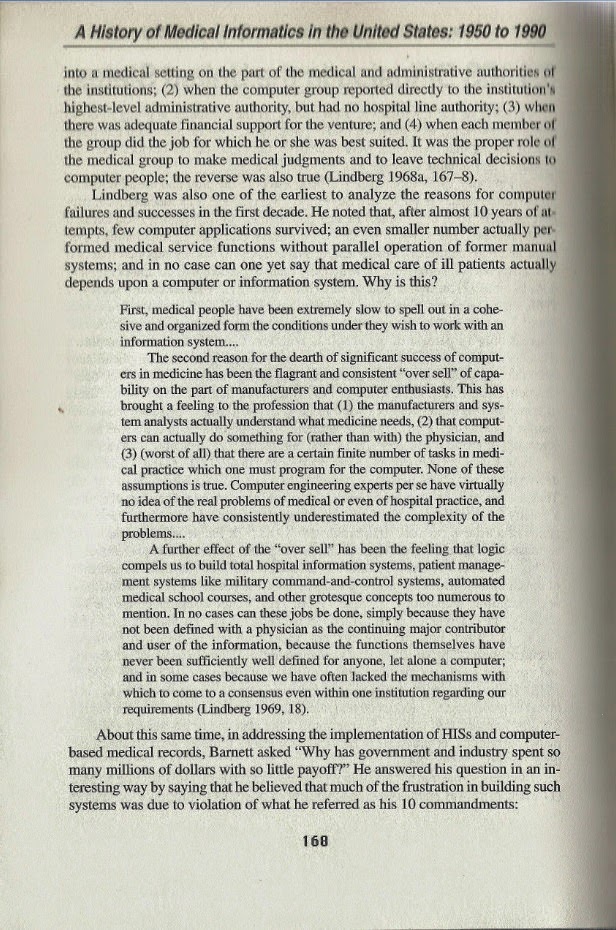
    Third, it's just a bit odd that the leader of the (failed) $20 billion National Programme for IT in the NHS, Richard Granger, said almost exactly the same thing about listening to end-users ca. 2007 (see http://hcrenewal.blogspot.com/2007/07/clinical-it-mayhem-is-good-for-it.html).  I as well as numerous other authors had similar observations, in some cases dating to the 1960's.  For example,  see my essays, some dating to the late 1990s at http://cci.drexel.edu/faculty/ssilverstein/cases/?loc=cases, and Dr. Donald Lindberg's quotes from 1969 at the page below from Morris Collen's book "A History of Medical Informatics in the United States 1950-1990."


    EHR pioneer Dr. Donald A.B. Lindberg (http://www.nlm.nih.gov/od/roster/lindberg.html), 1969:  "Computer engineering experts per se have virtually no idea of the real problems of medical or even of hospital practice, and furthermore have consistently underestimated the complexity of the problems ... in no cases can these jobs be done, simply because they have not been defined with a physician as the continuing major contributor and user of the information." (Click to enlarge)

    The essential nature of clinicians actually having input (and at a leadership level) into the design and implementation of clinical tools such as health IT is patently obvious.  Only in the perverse control-mentality of business information technology (a.k.a. MIS or management information systems, see http://hcrenewal.blogspot.com/2008/05/seedie-society-for-exorbitantly.html for the possible pre-electronic computer, tabulator-based roots of that culture) could such a precept even be questioned, let alone ignored.

    ... Moore, who took over as administrative lead on the electronic health record system after Thaw resigned, said some of the issues outlined in the physicians’ letter were real, and some were “theoretical.”

    Translation: some of the complaints were accidents waiting to happen.

    ..."To the best of our knowledge, there was not patient harm or patient death.”

    In other words, this is yet another story where the common, feel-good and ignorant refrain "but patient care has not been compromised" has reared its ugly head.  (I've made this type of claim a topical header at this blog.  See query link http://hcrenewal.blogspot.com/search/label/Patient%20care%20has%20not%20been%20compromised for others.)

    Assuming that's true - note that the impact of bad health IT can be delayed due to delayed effects of bad or missing information - this statement is, let me be impolite, vacuous on its face.

    vac·u·ous (http://www.merriam-webster.com/dictionary/vacuous)

    adjective \ˈva-kyə-wəs\
    : having or showing a lack of intelligence or serious thought : lacking meaning, importance, or substance

    It seems some simple facts apparently need to be explained to these geniuses.   I'll put it in caps just to make sure they understand some basic issues:

    • A HOSPITAL IS NOT A PLACE FOR RISKY INFORMATION TECHNOLOGY EXPERIMENTATION.   UNNECESSARY RISK IN HEALTHCARE IS A VERY, VERY BAD THING.
    • THE GOAL OF HOSPITALS IS NOT TO SUBJECT PATIENTS TO RISK VIA MISMANAGEMENT OF HEALTHCARE IT, AND THEN PROCLAIM "NOBODY WAS INJURED OR KILLED" AFTER THE PERPETRATORS OF THE MISMANAGEMENT ARE UPROOTED.
    • CLINICIANS DO NOT TOIL IN HOSPITALS TAKING CARE OF SICK PATIENTS SO THAT INFORMATION TECHNOLOGY PERSONNEL CAN HAVE COMFY JOBS AND COOL COMPUTERS.

    One wonders if these points might be above the intellectual pay grade of those running hospitals - including boards - in 2014.

    If nobody was injured or killed, it was due to happenstance, not due to appropriate due diligence and adherence to the standards of care essential in this healthcare sector - that is, healthcare information technology.

    Depending on happenstance is not a good healthcare management strategy.

    -- SS