Showing posts with label Microsoft. Show all posts

Tuesday, September 20, 2016

Cancer is just a software platform problem: Microsoft will 'solve' cancer within 10 years by 'reprogramming' diseased cells

A short post.

Hand a computer scientist a computer and some genetic data, and the world then becomes a deterministic, binary place:

Microsoft will 'solve' cancer within 10 years by 'reprogramming' diseased cells
Sept. 20, 2016
Sarah Knapton, Telegraph science editor
http://www.telegraph.co.uk/science/2016/09/20/microsoft-will-solve-cancer-within-10-years-by-reprogramming-dis/


Microsoft has vowed to “solve the problem of cancer” within a decade by using ground-breaking computer science to crack the code of diseased cells so they can be reprogrammed back to a healthy state.

Chris Bishop, laboratory director at Microsoft Research, said: “I think it’s a very natural thing for Microsoft to be looking at because we have tremendous expertise in computer science and what is going on in cancer is a computational problem.

"What is going on in cancer is a computational problem" sounds like a form of cybernetic scientism (https://en.wikipedia.org/wiki/Scientism) in this sense:

Scientism ... is a term that is used, often pejoratively, to denote a border-crossing violation in which the theories and methods of one (scientific) discipline are inappropriately applied to another (scientific or non-scientific) discipline and its domain. 

We are only scratching the surface in genomics, and to state it is merely a "computational problem" as if biology worked like a deterministic, binary digital computer is, in my mind, wishful thinking.

It would be great if genetics were just one big Intel Core I7 that one could program in binary assembly language after decoding its instruction set, but I have doubts it's that simple.

-- SS

9/21/16  Addendum

Medicinal chemist/scientist Derek Lowe has written the "long version" of this at http://blogs.sciencemag.org/pipeline/archives/2016/09/21/better-faster-more-comprehensive-manure-distribution

Hat tip to commenter Bruce Grant.

-- SS

Friday, March 11, 2011

Is Microsoft slowly edging towards an "exit stage left" in health IT?

Interesting item seen here:

From Dabney: “Re: former Sentillion exec departures from Microsoft. Microsoft transferred their 800 Health Solutions Group people into the small-to-medium commercial sector group (Microsoft Business Solutions) last Monday. Peter Neupert and his whole organization have been pushed out of the incubation group in Microsoft Research with the guys who sell Microsoft Axapta ERP and CRM for small commercial customers. That will mark the end of acquisitions and spending of Microsoft on health because they haven’t had any significant sales of Amalga UIS in the past year after already withdrawing Amalga HIS and Amalga RIS/PACS from the market. Microsoft is slowly edging towards an exit stage left in health IT.

Why would this not surprise me if true?

Because I predicted it.

In July 2006, nearly 5 years ago, in my July 2006 post "Bill, Have You Lost Your Mind?"

Nobody was listening, just as nobody seems to be listening to my current dire predictions for the National Program for IT in the HHS™ .

Wait until 2016...

-- SS

Thursday, February 24, 2011

Windows 7 Service Pack 1 "Glitches": Why Personal Computers are Problematic, and Perhaps Should Not Be Mission Critical Components in Hospitals

A technical note on computer unreliability, and a series of followup critical questions relative to health IT:

I run Windows 7 Professional on one of my computers, a very unspecial 4-5 year old Micro Center machine, the PowerSpec 6001, using conventional components. The machine was upgraded with 2 Gb RAM and an ATI Radeon 9600 series video card, to run the Aero "eye candy."

It has run satisfactorily since I installed Windows 7 Professional (32-bit version) on it last year.

I am not a computer amateur. [I do, however, admit to being a Radio Amateur - Extra class - ed.] Further, I meticulously keep the machine current with Microsoft security patches, use Symantec anti-virus which I also keep updated, check my disk for errors, and only visit major well-known, nationally prominent websites using the machine.

So yesterday, Windows 7 Service Pack 1 appeared in my "Software updates" list from Microsoft, after being released to the general public.

It was explained that this Service Pack improves performance, reliability and security [i.e., it is intended to update all the many, many bugs, unreliabilities and security holes of the operating system since its inception - ed.]

I confirmed my machine met the specs for it, and allowed the computer to download and install Service Pack 1.

That was my mistake.

After installation, the machine could no longer reboot Windows.

The flying color patches of the first screen appeared ... and then the machine suffered a hard reboot (going back to the BIOS-initiated memory checks and screens, etc.), as if I'd pressed the front panel hardware RESET button this machine has.

An automated "wizard" that came up and tried to figure out why the machine would not restart failed to do so.

I asked the machine, therefore, to roll back to the state it was in prior to the Service Pack 1 (SP1) "upgrade" via a "Restore Point", a feature Windows permits using the "system restore" capability. The SP1 installation automatically creates a Restore Point (image of the prior state of the OS) on the machine just before installing itself.

The machine works again, but ... (and that is a big "but"):

  • The Service Pack is not installed. Therefore I am not running the latest protections, and do not know what will happen in the future with respect to patches and upgrades. Maybe the Service Pack will get its own Service Pack at some point to fix it, so it can fix my computer;
  • The Service pack installation, without warning and rather rudely, erased my prior computer Restore Points of the past few weeks, leaving only the Restore Point it created just before inflicting itself on my machine. Just to thumb its nose at me, it also left two Restore Points from back in November, which would require me to then re-install a lot of software and updates at the very least. I cannot even try a Restore Point of, say, last week after other updates;
  • I attempted to view the system error logs to determine what caused the failed Service Pack Install. Surprise! The Event Viewer and Task Scheduler management consoles I use to review system operation no longer operated, instead producing this lovely, extremely explanatory message: "MMC cannot initialize the snap-in", followed by hexadecimal gibberish that any doctor or citizen can easily decipher:
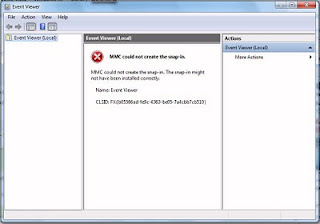
Such explanatory error messages! "MMC cannot initialize the snap-in. The snap-in might not have been installed correctly. Name: Event viewer. CLSID: FX: {b05566ad-fe9c-4363-be05-7a4cbb7cb510}." Click to enlarge.

  • Attempts to look up the error on the Web produce gobs and gobs of amateurish "legible gibberish", indirection, misdirection, guesswork, and speculation, some of it from Microsoft itself;
  • To add insult to injury, typical of poor user interaction design, I could not copy-and-paste the error, but had to type it (partially, fortunately, thanks to Google);
  • Much of the material was in very broken English (where's those language translators promised to us for some 50 years now by computer scientists?)
  • My attempts at repairing the damage by running the command "SFC /scannow" (system file check) to check and repair critical windows files showed that the Service Pack "Upgrade" also corrupted a number of critical Windows system files - despite the "Restore Point" rollback. Great Scott!
  • SFC repaired the files and produced a log of gibberish that's thousands of pages long for me to ferret out what got damaged (ironically, just like the records from a few weeks of a relative's EMR-error-related hospitalization, at appx. 2,900 pages of legible gibberish);
  • The repair did not restore the missing functionality;
  • Attempts to reinstall supporting packages such as .Net framework also do not restore the functionality;
  • Attempts to reinstall the Service Pack produce the same results, a crash on initial restart after the installation and need to roll back, erasure of several Restore Points I manually created, along with re-corruption of the critical system files previously repaired by the SFC /scannow command.
  • I have no way of knowing what else is broken or may malfunction;

Russian Roulette, anyone?

All this was after many months of Microsoft "Beta testing" the Service Pack. (Perhaps it was really "Alpha testing?")

Similar issues occurred with the former Microsoft OS, Windows XP (now in its third major service pack since its release in 2002, with patches still coming on an almost weekly basis).

Fortunately, I have backup images of my entire disk, but the inconvenience and time wasted is quite irritating - and I will still not have the latest security patches after I roll back my machine to my latest disk image.


One should note that these "glitches" are just in the Operating System (OS) itself. Third-party applications (such as EMR and CPOE sytems, middleware, interfaces, etc.) suffer the same type of problems...for instance, the life-and-limb-threatening "glitches" that occurred at Trinity Healthcare after an EMR "upgrade."

Further, OS "glitches" can cause unexpected application "glitches", and vice versa. Complexity on top of complexity...

Note that machines running similar software are on the "servers" that are the heart of major enterprise systems such as EMR's and CPOE's, that communicate with enduser workstations.

Now, several simple questions:

  • Who knows what other "glitches" the Service Pack introduced to my machine, that will "bite me" (or patients) later?
  • Are these the machines we want our doctors and nurses to depend upon, since they increasingly regulate every medical transaction that occurs?
  • Has the software become too complex to be entirely reliable, maintainable and secure?
  • Does the average hospital have the staff to effectively deal with issues such as the above?
  • Do these "glitches" raise the risk and the cost - therefore reducing the ROI, already low (see reading list) - of experimental health IT to even more unsatisfactory levels?

Finally:

  • Would the average person tolerate such behavior from their car? In their aircraft? (Oops, the brakes don't work properly in 13.5% of cars after the parts upgrade, and that altimeter is simply crazy ...)
-- SS

Feb. 24 late night addendum:

Deciding to play with this mayhem, and knowing I was going to be wasting a lot of time, I first backed up my deranged machine to an external disk (~ half an hour) to preserve my files. I then restored my machine from an external disk backup image to its condition in mid-Nov. 2010 [thinking perhaps something more recent caused the SP1 to fail]. That took another half an hour. I then attempted to install the SP1 again. That took another hour or more.

Same results - machine crash after the "circling window panes" display.

I let the "Startup Repair" wizard run. It failed with the following informative messages. In a superb example of poor user design, I had to jot the messages down on paper, as it made no offer to print them, or load them into a thumb drive, etc. - although it did offer to send the error messages to Microsoft, a neat trick as the software components to drive the computer's wireless network adapter were not loaded:

Problem details - System Repair
Problem signature:

1- 6.1.7600.16385
2- 6.1.7600.16385
3 - unknown
4 - 21201077
5- AutoFailure
6 - 3
7 - BadPatch

OS version - 6.1.7600.2.0.0
Local ID - 1033256.1
Root cause - a patch is preventing the system from starting [no fooling - ed.]
Repair Action
System file integrity check and repair
Result = Failed.
Error code = 0xa

Then for added fun, I started the machine up in 'Safe Mode' (using the F8 key at startup). It came up, but told me it was doing a System Restore due to the failure to configure the Service Pack. After about 20 minutes of frantic disk activity, the machine rebooted - and immediately crashed as before.

I am rerunning the Startup Repair wizard again, asking it to restore my system, but I predict it will do so with the original remaining problems of non-functioning components that started this whole mess - if it works at all.

This is all absurd. It is a massive waste of time, a result of poor programming, uninformative, cryptic error messages (what? computers don't have enough storage for useful error messages?), poor (nonexistent) documentation, inadequate attention to the user experience, condescension of the user, inability to report the problems back to HQ automatically due to lack of forethought about a compromised machine's ability to access the network, software unreliability, and probably a host of other issues I haven't thought of yet because I'm tired after all this fritter.

Not to mention, it is potentially destructive of data to those who suffer this problem but did not keep backups. They warn you beforehand - but the installation agreement you "sign" is of the Ross Koppel/David Kreda "hold the vendor harmless" variety.

This experience is a metaphor for the state of health IT (with "glitches", "workarounds", unexplained errors, etc.), and of the dangers of computer worship.

-- SS

Feb 25 addendum - further experimentation based on web comments about SP1, such as running a pre-SP1 readiness checking utility by Microsoft, emptying the /temp folders, renaming the "software distribution" folder, clean booting, etc. all produce the same result: crash of the machine on reboot.

And there's no computer doctor to call for an appointment to fix the problem.

-- SS

Wednesday, December 01, 2010

The Economist, Information Privacy, Microsoft, and Technological Determinism: An Online Debate

At The Economist, an online "debate" entitled Health 2.0 has been posted (link). It poses a debate between two experts.

In this case, the debate is between Peter Neupert, Corporate vice-president, Microsoft Health Solutions Group, vs. Deborah Peel, MD, Founder, Patient Privacy Rights and leader of the Coalition for Patient Privacy.

The readers are asked to vote upon whether they agree or disagree with this statement:

This house believes that any loss of privacy from digitising health care will be more than compensated for by the welfare gains from increased efficiency.

Note the phrase "will be."

Readers are also permitted to post comments.

My response was as follows:

30/11/2010 19:16:26 pm

Dear Sir,

The premise of this entire debate is logically fallacious, in fact begging the question.

This statement implies proven or inevitable "gains" from health IT. This is far from certain.

Health IT such as electronic medical records systems and computerized order entry systems (CPOE) remain highly experimental medical devices. They are unregulated devices as well. Their effects on medical care can be toxic, and patients are exposed to these effects without informed consent. The "gains" attributed to them are increasingly doubted in a growing body of literature.

See

"Common examples of healthcare IT difficulties" at http://www.ischool.drexel.edu/faculty/ssilverstein/cases/

and

"2009 a pivotal year in healthcare IT"
at
http://www.ischool.drexel.edu/faculty/ssilverstein/cases/?loc=cases&sloc...

for exposure to some of this literature.

In essence, management information systems and other business computing-derived approaches, customs and traditions for software design, development and lifecycle have proven ill suited in healthcare. Clinical computing and business computing are conflated; yet, they are two fundamentally different subspecialties of computing.

Further, medicine is a scientific discipline, yet the approach to IT in healthcare has been nearly devoid of science and critical thinking.

Sacrificing privacy for a dream that may or may not be true is not good social policy.

In the aftermath of the latest Wikileaks disclosures, a scientific approach - such as assertions about the beneficence of IT in healthcare not being made without strong, robust scientific evidence and without consideration of the downside evidence not being proferred so freely - would be a fine start.

S. Silverstein, MD
Drexel University
College of Information Science and Technology
Philadelphia, PA USA.


I found the position of Peter Neupert (Corporate vice-president, Microsoft Health Solutions Group) defending the motion particularly concerning:

Consumers must trust that the organisations they are engaged with are accountable and will respect—and protect—the privacy of their data.

"Must trust?"

I find this remarkable in the context of repeated violations of "trust" I've noted at this blog such as at my posts:


Neupert's view is especially paternalistic and naive in the context of Wikileaks repeatedly and recently leaking hundreds of thousands of supposedly secure documents, stolen from U.S. intelligence by at least one known person and probably others. If the Pentagon and U.S. intelligence cannot keep information secure, how can lowly hospital IT departments?

The moderator's initial comments are also disturbing:

... Supporters argue that health information technologies have advanced to the point that such [security] concerns are vastly overblown. After all, do not financial data flow freely and with little incident over digital systems? On this argument, any loss of privacy will be more than offset by efficiency gains. In arguing for the motion, Peter Neupert of Microsoft, a software firm, insists that digital medicine must be centred on the patient—rather than, say, the doctor or the insurer, as is often the case today [this 'centered on the patient' meme sounds good, but what exactly does it mean? - ed.] —and that medical information must be as mobile as the patient. If that is the case, he argues, it is not merely the efficiency of health systems that will improve but also the value of health care—and perhaps health outcomes too.

MR VIJAY V. VAITHEESWARAN
Correspondent, The Economist

Note the statements of absolute certainty - "will be more than offset by efficiency gains", "will improve", etc. They remind me of the statements made in the NEJM by the Director of ONC, Dr. David Blumenthal, as I wrote at "Science or Politics? The New England Journal and The 'Meaningful Use' Regulation for Electronic Health Records":

The widespread use of electronic health records (EHRs) in the United States is inevitable. EHRs will improve caregivers’ decisions and patients’ outcomes. Once patients experience the benefits of this technology, they will demand nothing less from their providers. Hundreds of thousands of physicians have already seen these benefits in their clinical practice.

On that I had commented:

Even though it is a "perspectives" article, I once long ago learned that in writing in esteemed scientific journals of worldwide impact, statements of certainty were at best avoided, or if made should be exceptionally well referenced. I note the lack of footnotes showing the source(s) of these statements.

The meme of technological determinism, that computerization in medicine is synonymous with, and will deterministically provide "improvements", no matter what the evidence, is quite concerning coming from a company as profoundly large and influential as Microsoft.

Further, the complete omission of consideration of the adverse clinical consequences (let alone mere information breaches) that may occur along the way to cybernetic utopia in healthcare is very disturbing. These are experimental medical devices, are unregulated, and are used without patient informed consent. Yet the IT industry seems to opine as if these systems are only to be used on experimental lab rats.

These systems produce "legible gibberish" of no clinical use to clinicians, but take clinician time to generate through distracting "clickorrhea." For example, just the placement of an IV and fluid infusion generates a half page of nonsense:


Actual "legible gibberish" from an ED EHR report, major health IT vendor. Half a page on how an IV was started and a saline infusion given. (How many distracting clinician mouse clicks did it take to produce this?) Click to enlarge.

Addendum 12/8/10 - From "Hidden Malpractice Dangers in EMRs", Steven I. Kern, Esq., Medscape.com:

Too Much Information

... Pages of repetitive documentation can be more time-consuming to review than brief, handwritten notes. When important information is embedded in paragraphs of boilerplate, it can easily be overlooked. The chance of missing critical data increases.

Overlooking important information is, of course, a significant cause of malpractice. A positive finding embedded in a string of negative findings can easily be missed.


Ironically, my relative was injured as a result of EHR-related disruption not long ago. Further, just the initial two and a half weeks of hospitalization generated more than 2,800 laser printed pages of "legible gibberish" (which cost just under $1000 to obtain; Kinko's should only have it so good).

A fellow physician I know well related:

From: [redacted name of MD]

Good Lord! I am so sorry to see this and hope your Mom gets better. You must be furious.

May I add to the cacophony? My wife went to [another local hospital's] ER for emergency transfusion. Their Emr displayed someone else's info under her name & SSN. Had I not been there she would have received incorrect treatment.

My wife went to [yet another hospital] for hip replacement. After surgery, while she slept off her anesthesia, a nurse came in and started injecting her. I asked and learned it was insulin. I stopped the nurse (with difficulty). My wife's not diabetic. Her screen showed someone else's orders. Had I not been there she might have died.

So keep up the good work... please!

[redacted name of MD]

How many other patients have been injured or killed as a result of EHR's?

In fact, we really don't know how many adverse events related to EHR's occur. As the Joint Commission itself admits in its Sentinel Events Alert #42, Safely implementing health information and converging technologies: "There is a dearth of data on the incidence of adverse events directly caused by HIT overall." I further wrote on this issue in a paper "A Dearth of Data on Unintended Consequences of Healthcare IT" here.

Is this a proper environment for national rollout of these clearly experimental medical devices, one should ask?

The memes of technological determinism and health IT "white-as-driven-snow" beneficence seem as difficult as vampires to eradicate.

Yet if this technology is to achieve the benefits of which it is capable via remediation of current IT industry customs, traditions and practices, these memes must be challenged and defeated.

Regarding health IT in the real world, reality matters.

-- SS

Wednesday, January 06, 2010

IT Religion and Windows 7 "God Mode"

I've written in the past that IT has become something of a religion, with computers as an altar or shrine, programmers and technicians as clergy, programming a sacrament, and an irrational exuberance and "faith" prevailing about the computer's miraculous capabilities despite growing literature to the contrary. Of course, my focus has been on computers in medicine.

I am generally very happy with Windows 7. Microsoft has done well, but this caught my attention:

Understanding Windows 7's 'GodMode'
CNET News
January 4, 2010 12:41 PM PST

Although its name suggests perhaps even grander capabilities, Windows enthusiasts are excited over the discovery of a hidden "GodMode" feature that lets users access all of the operating system's control panels from within a single folder.

By creating a new folder in Windows 7 and renaming it with a certain text string at the end, users are able to have a single place to do everything from changing the look of the mouse pointer to making a new hard-drive partition.

... To enter "GodMode," one need only create a new folder and then rename the folder to the following:

GodMode.{ED7BA470-8E54-465E-825C-99712043E01C}

Once that is done, the folder's icon will change to resemble a control panel and will contain dozens of control options.

I've tried it, and it works. Upon renaming a new desktop folder as above, the folder actually transforms into the following icon and label:


Then, on opening the "God Mode" icon a comprehensive list of control options appears. Very convenient and useful.

While the name was clearly intended to be humorous, I think that the originators of this name could and should have come up with a less theistic name. Not on religious grounds, but on psychological ones - i.e., the impact such nomenclature might have on IT personnel.

I'm already seeing comments such as "Did you know that you can become a God? Well, at least on Windows 7!" on IT enthusiast sites...

The culture of IT is already patronizing enough towards end users, thank you very much.

I felt the same way ca. 1976 when visiting professors from MIT implemented the programming language "Logo" on Boston University's IBM 370-based RAX timesharing system. The RAX/370 monitor command for restarting after a Logo interpreter fault was "RESAT GOD" (resume at symbolic address 'God', a symbol defined by the professors to represent an address in the 370's user program address space). Since the Logo interpreter was in beta, I had to type that Charlton Heston-esque command often...

Note: having spent some time in Saudi Arabia, I'm not sure how well this Windows 7 holiness will go over in that part of the world...

-- SS

Addendum: I've discovered that renaming a folder to, say, "Bob.{ED7BA470-8E54-465E-825C-99712043E01C}" creates an icon with identical capabilities, but with a ... somewhat less presumptuous name. :)


Friday, October 16, 2009

Data Malpractice on T-Mobile Sidekick: But Don't Worry, Your Medical Data is Safe

One of the promises made about healthcare IT is that your medical data is "safer" in electronic form than in paper form. The Hurricane Katrina example of paper records being destroyed is often used as a poster example of the dangers of paper records.

However, the risk of electronic storage of information, especially the talk of national EMR's stored on the "cloud" (an amorphous term meaning distributed storage "out there" whose physical sites and boundaries are supposedly irrelevant from the user's perspective) has also been under-reported. Excluding frequent reports of data confidentiality breaches, we also have this:

Wall Street Journal, Oct. 15, 2009
Microsoft Recovers Lost Sidekick Data
By ROGER CHENG

Microsoft Corp. said Thursday that it has been able to recover the personal customer data lost from many of T-Mobile USA's Sidekick devices.

The Redmond, Wash., software giant said that most, if not all, customer data was recovered, and that the company would begin restoring data as soon as it has validated it. The company said it will start with personal contacts, and move on to the lost calendar, notes, tasks and pictures as quickly as possible.

The fix comes as Microsoft suffers through a public backlash after mishandling the information found on the Sidekick line of messaging phones, which are popular with teenagers ... Over the weekend, T-Mobile and Microsoft initially warned that the recovery of data would be unlikely, but upgraded their prospects on Tuesday.

They got lucky.

Microsoft blamed a system failure [i.e., an IT system - ed.] for the data loss in the core database and backup system. Microsoft said it had taken steps to strengthen the stability of the Sidekick service and started a more resilient backup process. [More resilient compared to ... what? - ed.]

In IT it's always an apersonal "system failure", not "data malpractice." When medical malpractice occurs, it's the doctor's fault, even if that malpractice occurred secondary to the failure or misdesign of an EMR or other clinical IT by dyscompetent software engineers. When data malpractice occurs, the motto is "We always blame the computer." How about some names of those responsible for this debacle?

... The Sidekick service, run by Microsoft unit Danger [talk about ironic names - ed.], is supposed to be more secure in storing data because it is kept in the "cloud," which involves storing information on the Internet and not one physically vulnerable location, making the temporary loss of data striking.

"Cloud" is a new buzzword du jour to make more appealing a basically bad idea for many fields. Distributing data also distributes risk that some incompetent or careless person or person(s) will cause data corruption or loss (yes, computers are run by people, and either they're in control of their systems, or their systems are in control of them). It also puts organizations storing data on the "internet cloud" at risk of being victims of a network "rainy day" when internet connections might prove unreliable (accidents, sabotage, natural disasters all come to mind).

In healthcare, using the "cloud" for data storage seems to be a bad idea, especially in an era of $99 (retail) terabyte hard drive storage, and corresponding economies in mission critical-grade local mass storage, backup, business continuity and disaster recovery capabilities.

In summary, is electronic medical data more secure when stored electronically than on paper? Only if the underlying CIO's, information stewards, technicians and system administrators are at least as competent and careful as the trained health information management (HIM) personnel in hospital medical records departments and doctors' offices.

Time will tell if that is the case. One mistake, and thousands or millions of records can go *POOF*.

Microsoft and T-Mobile were lucky ... this time.

-- SS

10/26 addendum:

Sometimes, EHR data simply disappears too. At this link is a story of a Canadian clinic that lost two years of electronic health records:


Clinic's medical files vanish

By Ryan Cormier, Edmonton Journal

October 21, 2009

During a recent investigation into whether a patient's confidentiality had been breached at the Fairview Medical Clinic, an investigator asked for a log of who had accessed the complainant's file. When the clinic responded that it had automated his records in 2004 but only had files from 2006 on, alarm bells rang.

"That raised a lot of questions," said Leahann McElveen, an investigator with the office of the information and privacy commissioner.

The clinic had permanently lost two years worth of health files that include patient information on visits, prescriptions, lab reports, doctor's notes and other information. The loss happened when the clinic switched from one electronic medical records system to another.

"They were two similar systems intended to do the same thing," McElveen said. "However, they weren't coded the same way behind the scenes. It's not that the records fall into the wrong hands, they just don't exist anymore."


*POOF* again.

-- SS